


Updated 29 October 2026
Women Enterprise Fund loans are made to registered women’s groups (chamas), not individuals. Under the Tuinuke Loan, a group borrows KSh100,000 in its first cycle and can grow to KSh750,000 by the fifth, with no interest and no collateral, just a one-time 6% administrative fee per cycle. Groups need 10 to 30 women aged 18 or over, registered for at least three months, with a commercial bank account and the Fund’s financial literacy training. Below are the loan cycles, the real cost, the requirements and how to apply at your constituency office.
Updated October 2026, from the Women Enterprise Fund’s official Tuinuke Loan page and FAQs on wef.go.ke.
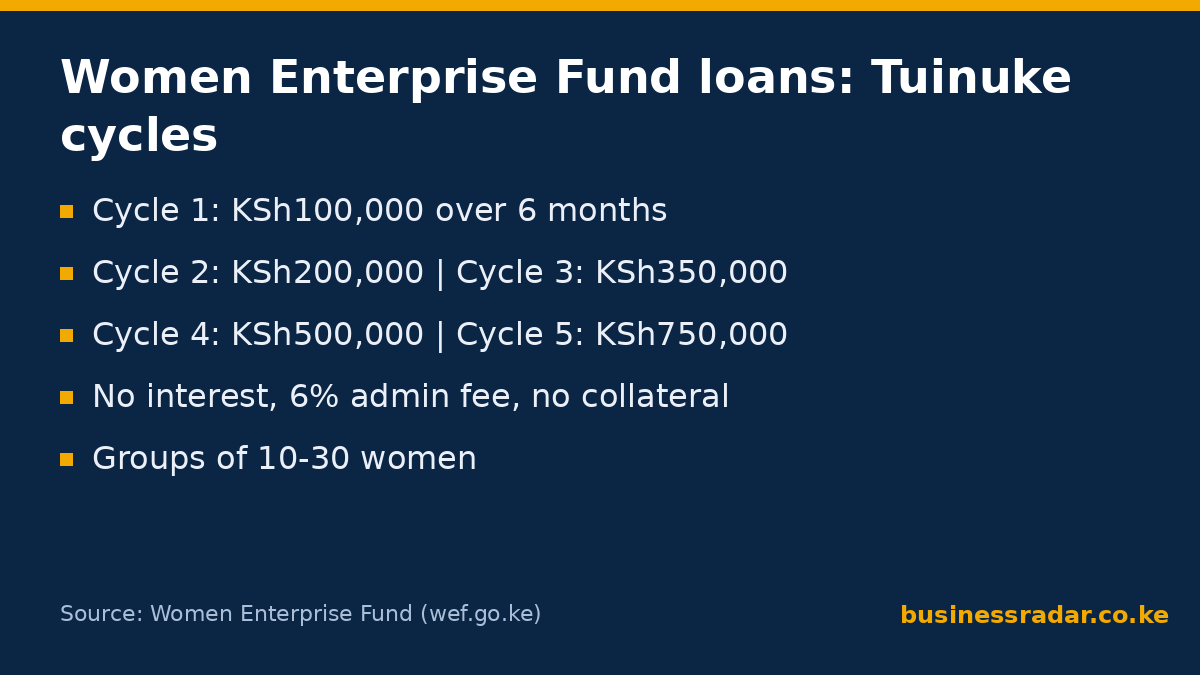
Women Enterprise Fund Loans: Tuinuke Cycles
The Tuinuke Loan follows a graduation model: repay on time and the group qualifies for a bigger loan next cycle.
| Cycle | Loan amount (KSh) | Repayment period | 6% admin fee (KSh) |
|---|---|---|---|
| 1st | 100,000 | 6 months | 6,000 |
| 2nd | 200,000 | 9 months | 12,000 |
| 3rd | 350,000 | 12 months | 21,000 |
| 4th | 500,000 | 15 months | 30,000 |
| 5th | 750,000 | 18 months | 45,000 |
The admin fee column applies WEF’s 6% to each loan amount. The group must fully repay the current cycle within its repayment period to move to the next.
What the Loan Really Costs
- Interest: none, according to WEF’s FAQs.
- Administrative fee: 6%, charged upfront on every cycle.
- Training fee: KSh100 per group member.
- Loan tracker booklet: KSh200 per loan cycle.
For a 15-member group taking the first KSh100,000, that is KSh6,000 + KSh1,500 training + KSh200 booklet = KSh7,700, with the training fee paid once.
Who Qualifies
- A registered self-help group of 10 to 30 women, all aged 18 or over.
- Registered with the Department of Social Services or the Micro and Small Enterprises Authority (MSEA) for at least three months.
- An account with a commercial bank. WEF says SACCO FOSA, Post Bank and deposit-taking microfinance statements are not accepted.
- Completed WEF financial literacy training. The certificate stays valid for later cycles unless the syllabus changes.
- Each member may belong to only one WEF-funded group.
Not registered yet? Start with our guide on how to register a chama in Kenya.
How to Apply for Women Enterprise Fund Loans
- Visit your nearest WEF constituency office. Officers sit in Deputy County Commissioner or Assistant County Commissioner offices in all 290 constituencies.
- Book the financial literacy training for the group.
- Collect and complete the loan application form.
- Submit it with your group registration certificate and bank account details.
- After approval, the money goes straight into the group’s bank account.
Women Enterprise Fund Loans vs Other Options
| Option | Borrower | Cost | Security |
|---|---|---|---|
| WEF Tuinuke Loan | Women’s group of 10-30 | 6% admin fee per cycle, no interest | None |
| Bank SME loan | Individual or business | Interest plus fees, set per customer | Often required |
| SACCO loan | Member | Interest set by the SACCO | Deposits and guarantors |
The group model keeps the cost low, but every member shares responsibility for repayment, so choose members carefully. Before you apply, agree a group constitution, hold regular minuted meetings and keep the bank account active; WEF officers look at how well the group is run as well as the business plan. Groups that already save together and lend among themselves usually find the jump to Women Enterprise Fund loans easiest.
How to Repay Through M-Pesa
Dial *222#, choose Make Payment, then Service Code, type WEF and enter your group account number (it starts with 501). Confirm the group details, enter the amount and your M-Pesa PIN. Keep the confirmation SMS for your loan tracker.
Growing Beyond the Group Loan
Women-owned businesses can also bid for government tenders reserved under AGPO; see our AGPO registration guide. For bigger amounts, compare lenders with our loan comparison tool, and make sure the business has its single business permit. Selling online? A .co.ke domain and hosting from Truehost (affiliate link) gives the group a simple shop window.
Making the Most of Women Enterprise Fund Loans
Groups that move up the cycles usually agree in writing how the money is shared, who repays what and what happens if a member leaves. Put each member’s share into a business with steady weekly sales, so repayments come from income, not from contributions. Women Enterprise Fund loans reward discipline: a clean first cycle opens the KSh200,000 second cycle.
Official Sources
Frequently Asked Questions
Does the Women Enterprise Fund charge interest?
No. WEF charges a 6% administrative fee on each loan cycle instead of interest.
Can an individual woman get a WEF loan?
The Tuinuke Loan is for registered women’s groups of 10 to 30 members, not individuals.
How much can a group borrow from WEF?
KSh100,000 in the first cycle, rising to KSh200,000, KSh350,000, KSh500,000 and KSh750,000 as the group repays on time.
Do we need collateral for a WEF loan?
No. WEF loans to women’s groups are collateral-free.
Checked on 28 October 2026 on wef.go.ke (Tuinuke Loan page and FAQs).
Prefer WhatsApp? Follow Business Radar on WhatsApp
We will email you a weekly money and business brief. We store your email (and your name, if you give one) for that purpose, under the Kenya Data Protection Act, 2019. You can unsubscribe at any time. Privacy policy.

