


Get breaking business news on WhatsApp
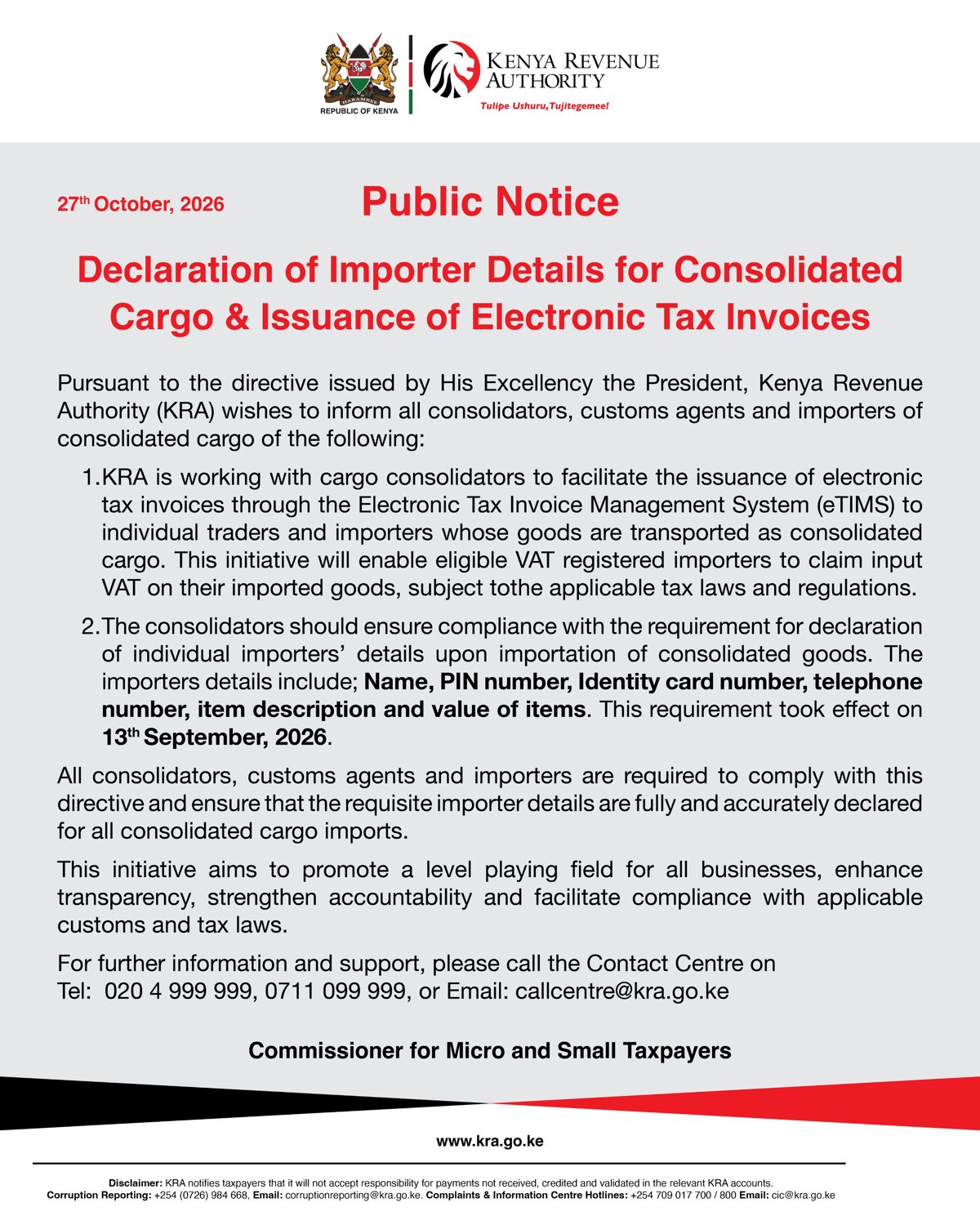
Under KRA consolidated cargo rules now in force, importers whose goods are shipped in shared containers must give their cargo consolidator six details for every consignment: name, KRA PIN, national ID number, phone number, a description of the items and their value. The Kenya Revenue Authority (KRA) set this out in a public notice dated October 27, 2026, and said the requirement “took effect on 13th September, 2026”.
The notice, issued by the Commissioner for Micro and Small Taxpayers, is addressed to “all consolidators, customs agents and importers of consolidated cargo”. KRA says it was issued “pursuant to the directive issued by His Excellency the President”.
What the KRA consolidated cargo notice requires
Consolidated cargo is freight from several small importers grouped into one shipment by a consolidator, a common route for traders who buy small volumes abroad. Before the KRA consolidated cargo requirement, the goods were often declared under the consolidator, not under each trader.
The notice has two parts. First, KRA says it “is working with cargo consolidators to facilitate the issuance of electronic tax invoices through the Electronic Tax Invoice Management System (eTIMS) to individual traders and importers whose goods are transported as consolidated cargo.”
Second, consolidators “should ensure compliance with the requirement for declaration of individual importers’ details upon importation of consolidated goods.” The details listed are:
- Name
- KRA PIN number
- Identity card number
- Telephone number
- Item description
- Value of items
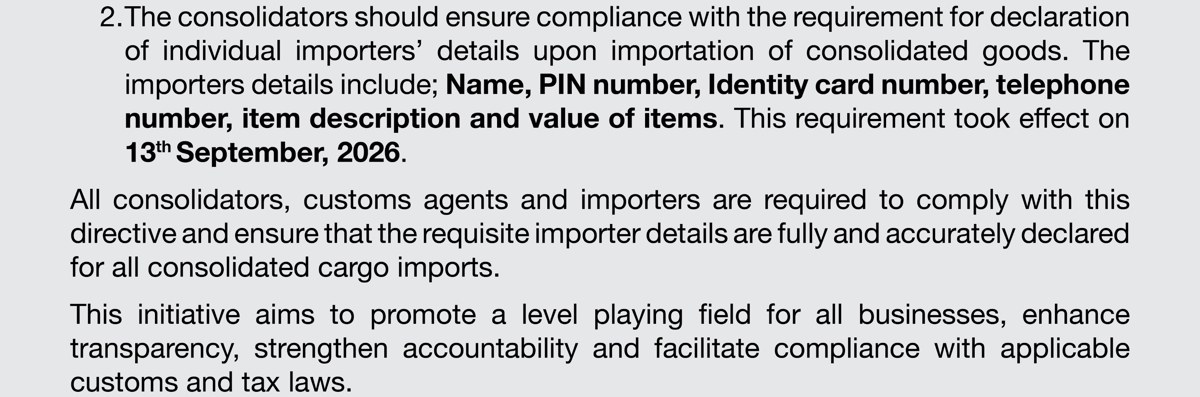
“All consolidators, customs agents and importers are required to comply with this directive and ensure that the requisite importer details are fully and accurately declared for all consolidated cargo imports,” the notice says.
Why KRA consolidated cargo invoices matter for input VAT
The main change for traders under the KRA consolidated cargo notice is the eTIMS invoice. KRA says the initiative “will enable eligible VAT registered importers to claim input VAT on their imported goods, subject to the applicable tax laws and regulations.”
A trader whose goods arrive in a shared container has, in many cases, had no import record under their own PIN. With an eTIMS invoice issued in their name, a VAT-registered importer has a document to support an input VAT claim, which KRA can match against its own records. Our guide on why KRA disallows input VAT claims explains how unmatched invoices are treated, and our step-by-step on how to generate an eTIMS invoice covers the system itself.
KRA says the measure “aims to promote a level playing field for all businesses, enhance transparency, strengthen accountability and facilitate compliance with applicable customs and tax laws.”
The KRA consolidated cargo notice does not set out penalties for consolidators or importers who leave out the details, and it does not say how traders who are not registered for VAT will be treated beyond the invoice. It gives the KRA Contact Centre lines, 020 4 999 999 and 0711 099 999, and the email callcentre@kra.go.ke for questions.
Other import rules in force this month
The KRA consolidated cargo requirement is one of several customs changes importers face this quarter. From today, November 1, KRA will block clearance of goods without digital marine cargo insurance from a locally licensed insurer. Since October 26, transporters moving transit and bonded goods have had to use KRA e-seals from approved vendors.
Small traders who buy from China through shared containers can estimate what they will pay at the port with our import duty calculator for goods from China. Shoppers bringing in parcels ahead of Black Friday can also check our guide to import duty on online shopping in Kenya.
Frequently asked questions
What details does KRA require for consolidated cargo?
Each importer’s name, KRA PIN, national ID number, telephone number, a description of the items and their value must be declared by the consolidator for every consignment.
When did the KRA consolidated cargo requirement start?
KRA says the requirement took effect on September 13, 2026. It reminded consolidators, customs agents and importers of it in a public notice dated October 27, 2026.
Can importers of consolidated cargo claim input VAT?
KRA says eTIMS invoices issued through consolidators will let eligible VAT-registered importers claim input VAT on their imported goods, subject to the applicable tax laws and regulations.
Who do I contact about KRA consolidated cargo questions?
KRA lists its Contact Centre on 020 4 999 999 and 0711 099 999, and the email callcentre@kra.go.ke.
Prefer WhatsApp? Follow Business Radar on WhatsApp
Weekly, free. We only use your email for this newsletter and you can unsubscribe in one click. Privacy policy.

