



Updated 28 October 2026
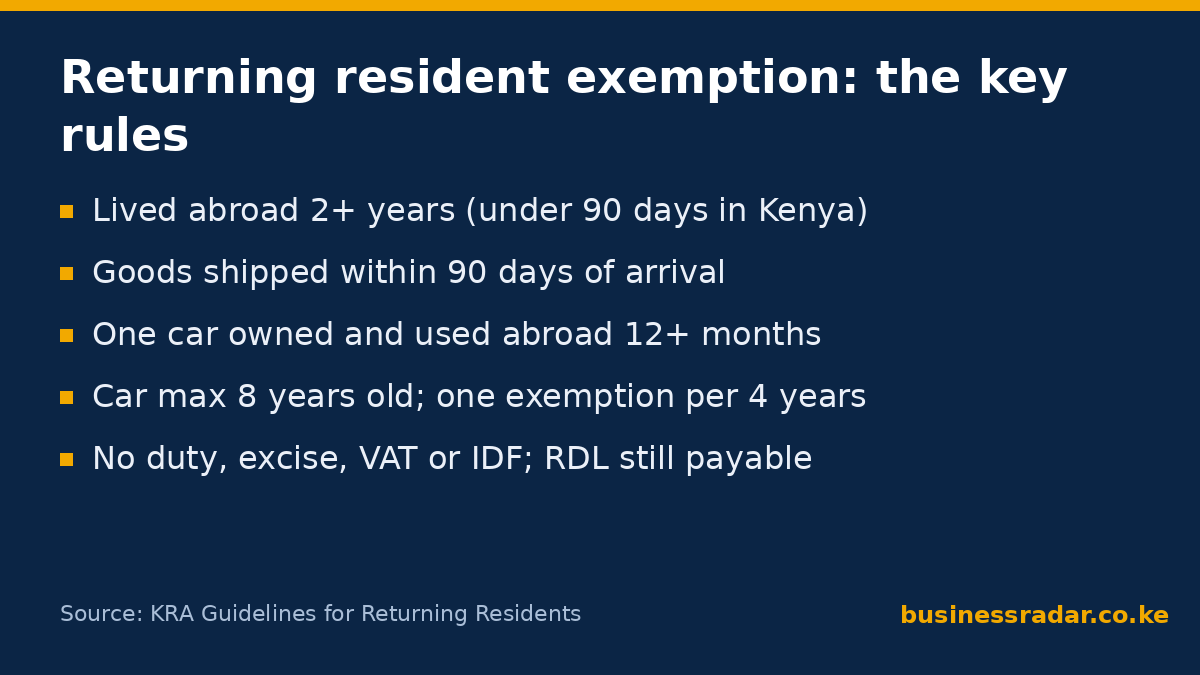
The returning resident exemption lets a Kenyan citizen moving home permanently bring in personal and household effects, and one motor vehicle, without paying import duty, excise duty, VAT or the Import Declaration Fee. You must have lived abroad for at least two years, the goods must have been in your personal use there, and they must arrive within 90 days of your return. The car must have been owned and used by you abroad for at least 12 months, and it must meet KRA’s age rule. This guide sets out every condition, the documents KRA asks for and the traps that cost returnees money.
Updated October 2026, from KRA’s Guidelines for Returning Residents and Customs FAQs on kra.go.ke.
Who Qualifies for the Returning Resident Exemption?
KRA’s customs FAQ defines a returning resident as someone changing residence from outside Kenya to Kenya who:
- has lived outside Kenya for at least two years, and
- has not spent 90 days or more in total in Kenya during the two years before returning.
You must be over 18 and permanently changing residence, not visiting. Spouses and children aged 18 and above can claim too if they meet the same conditions.
Which Taxes Are Waived
| Tax | Exempt? | Legal basis (per KRA) |
|---|---|---|
| Import duty | Yes | EACCMA 2004, 5th Schedule Part B Item 5 |
| Excise duty | Yes | Excise Duty Act, 2nd Schedule Part A Item 6 |
| VAT | Yes | VAT Act, 1st Schedule Part 1 Item 99 |
| Import Declaration Fee (IDF) | Yes | Miscellaneous Fees and Levies Act, 2nd Schedule |
| Railway Development Levy (RDL) | No, still charged | Section 8, Miscellaneous Fees and Levies Act |
What Goods Are Covered
- Wearing apparel (clothes).
- Personal and household effects of any kind that were in personal use where you lived abroad.
- One motor vehicle, excluding buses and minibuses seating more than 13 passengers and load-carrying vehicles over two tonnes.
New, unused items bought just before shipping are the most common point of dispute, because the exemption covers goods that were in personal use.

Returning Resident Car Rules
- You personally owned and used the car outside Kenya for at least 12 months, not counting the time at sea.
- The car must not be more than eight years old from the date of manufacture (see the KEBS 8-year rule).
- You have not had a similar car exemption in the last four years, and all duty on any earlier exempted car has been paid.
- Interpol clearance is required for the vehicle.
- Replacing a left-hand-drive car: you need proof you disposed of it, the right-hand-drive replacement’s retail price can’t exceed the old car’s, and the country you are returning from must drive on the left.
If you don’t qualify, budget for the full taxes with our guide to car import duty rates in Kenya, and see how to import a car from Japan for the shipping steps.
Deadlines: The 90-Day Rule
Goods must be shipped and imported within 90 days of your arrival. The Commissioner can approve a longer period, up to 360 days in total, so ask early if your shipment will be late.
Documents KRA Asks For
- Invoice, bill of lading or air waybill, and packing list.
- Passport with entry and exit stamps (current and previous passports used in the last two years).
- Evidence of residence abroad: work or residence permit, visa or student permit.
- Evidence of return: passport entry stamp, end of contract.
- For a car: proof of ownership for at least 12 months and Interpol clearance.
A licensed clearing agent will usually lodge the entry; our guide on how clearing agents charge at Mombasa Port explains their fees. Need a local account before you land? See how to open a Kenyan bank account from abroad.
Making the Returning Resident Exemption Work for You
Plan the move around the returning resident exemption rather than discovering it at the port. Ship household goods soon after you land so you stay inside the 90 days. Keep your old passports, because customs reads the entry and exit stamps to confirm the two-year rule. If you are bringing a car, keep the purchase papers and registration from abroad to prove 12 months of ownership, and check the year of manufacture before you ship. If any condition fails, the returning resident exemption doesn’t apply to that item and full taxes are due.
Official Sources
Frequently Asked Questions
How long must I live abroad to qualify as a returning resident?
At least two years, without spending 90 days or more in total in Kenya during those two years.
Can I bring a car duty-free as a returning resident?
Yes, one car you personally owned and used abroad for at least 12 months, no more than eight years old, if you haven’t had a similar exemption in the last four years.
Do returning residents pay VAT?
No VAT, import duty, excise duty or IDF on qualifying goods. The Railway Development Levy is still charged.
How long do I have to ship my goods?
90 days from arrival, extendable by the Commissioner up to 360 days.
Checked on 28 October 2026 against KRA’s Guidelines for Returning Residents, the Customs FAQ brochure and KRA’s Exemption (Customs) FAQs.
Prefer WhatsApp? Follow Business Radar on WhatsApp
Weekly, free. We only use your email for this newsletter and you can unsubscribe in one click. Privacy policy.

