


Updated 28 October 2026
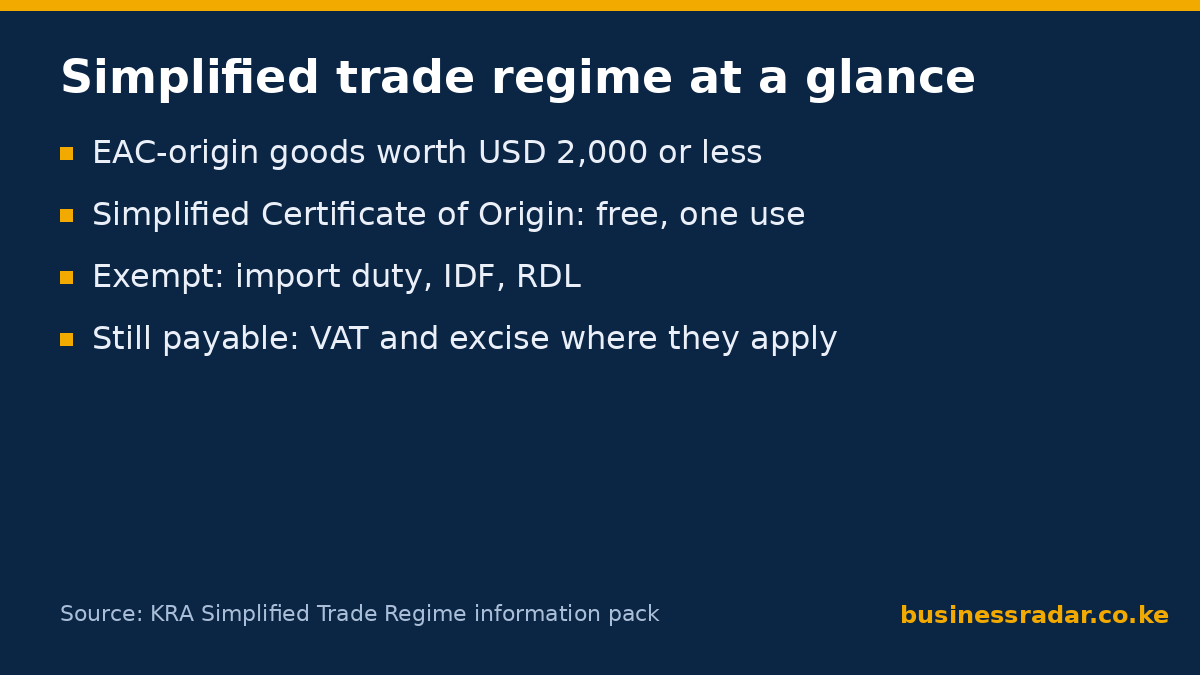
The simplified trade regime (STR) lets small traders move goods that originate in the East African Community, worth USD 2,000 or less per consignment, across EAC borders without paying import duty. At the border, customs issues a free Simplified Certificate of Origin (SCOO) for each consignment. It exempts the goods from import duty, the Import Declaration Fee (IDF) and the Railway Development Levy (RDL) in Kenya, but not from VAT or excise duty. This guide explains who qualifies, the step-by-step border process, what you still pay and the mistakes that get goods taxed in full.
Updated October 2026, from KRA’s Simplified Trade Regime information pack for MSMEs (Customs and Border Control).
What Is the Simplified Trade Regime?
KRA describes the STR as a special provision under the EAC Customs Union aimed at small traders who regularly move low-value consignments. Its tools are:
- A value threshold: USD 2,000 per consignment, the figure agreed in both the EAC and COMESA.
- A common list: the products that get preferential treatment under the regime.
- The Simplified Certificate of Origin (SCOO): a short form issued at the border.
- A Simplified Customs Document: used to declare common-list goods on which no duty is payable.
Above USD 2,000, you follow standard import and export procedures, usually through a licensed clearing agent.
Who Qualifies Under the Simplified Trade Regime
A consignment qualifies when both conditions are met:
- The goods originate in the EAC, meaning they were wholly produced or manufactured in a partner state.
- They are valued at USD 2,000 or less.
KRA lists commonly traded STR goods as agricultural products (unprocessed, semi-processed and processed), organic chemicals, plastics, textiles and fabrics, glassware, motor vehicle parts, paper and printed matter, and machinery and mechanical appliances.
Goods bought from outside the EAC, for example items made in China, don’t qualify even if they are cheap. For those, import duty, IDF and RDL are payable; work out the bill with our import duty calculator for goods from China.
How to Export Under STR, Step by Step
- Go to the customs office at the border with the goods and a commercial invoice or receipt.
- Customs checks that the goods qualify as originating in the EAC.
- Once satisfied, customs gives you the SCOO and guides you to fill it in.
- Customs signs and stamps the completed SCOO, and the goods can cross.

How to Import Into Kenya Under STR
- Present the goods, commercial invoice, any permits and the SCOO to Kenyan customs.
- Customs checks the goods against the SCOO and verifies the signature and stamp.
- The officer enters a direct assessment in the customs system and prints a receipt for any tax payable.
- If no VAT or excise is due, the goods are released. If VAT or excise is due, you pay at the bank, show the payment and the goods are released.
What You Still Pay, and What You Don’t
| Charge | EAC goods with a SCOO | Non-EAC goods or no SCOO |
|---|---|---|
| Import duty | Exempt | Payable |
| Import Declaration Fee | Exempt | Payable |
| Railway Development Levy | Exempt | Payable |
| VAT | Payable where it applies | Payable |
| Excise duty | Payable where it applies | Payable |
| SCOO fee | Free | – |
How customs values your goods matters once tax is due; see the six customs valuation methods KRA uses.
Five Rules That Trip Up Small Traders
- One SCOO, one transaction. A certificate can’t be reused for the next trip.
- The SCOO comes from the exporting side. Completed SCOOs are verified, endorsed and issued by customs in the exporting country.
- Splitting a big consignment to stay under USD 2,000 is a compliance risk: above the threshold, standard procedures apply.
- Prohibited goods stay prohibited, including counterfeit goods, narcotics, hazardous waste, soaps and cosmetics containing mercury, used tyres for cars and light commercial vehicles, and worn undergarments.
- Restricted goods need permits even under STR, for example plant and animal health certificates for farm produce.
For bigger, regular shipments, a licensed agent is worth it; see how to get a clearing and forwarding licence if you plan to clear for others. Buying online rather than at the border? Read KRA duty and courier charges explained.
Is the Simplified Trade Regime Right for Your Business?
The simplified trade regime suits traders who cross often with small, EAC-made loads: produce, fabrics, plastics or spare parts bought in Kampala, Arusha or Kigali. It saves import duty and the clearing agent’s fee. Once a business regularly ships more than USD 2,000 a load, or sources from outside the region, the simplified trade regime no longer fits, and a registered agent and full declaration are the safer route.
Official Sources
- KRA: Simplified Trade Regime for MSMEs information pack (PDF)
- KRA Customs and Border Control (call centre 020 4 999 999)
Frequently Asked Questions
What is the STR limit in the EAC?
USD 2,000 per consignment, as agreed in the EAC and COMESA.
How much does a Simplified Certificate of Origin cost?
Nothing. KRA says the SCOO is issued free of charge at the border station, once per transaction.
Do I pay VAT under the simplified trade regime?
Yes, where VAT or excise applies. The SCOO only exempts import duty, IDF and RDL.
Can I use STR for goods made outside the EAC?
No. Only goods that originate in the EAC qualify. Non-EAC goods pay full import duty, IDF and RDL.
Checked on 28 October 2026 against KRA’s Simplified Trade Regime for MSMEs information pack (Customs and Border Control).
Prefer WhatsApp? Follow Business Radar on WhatsApp
Weekly, free. We only use your email for this newsletter and you can unsubscribe in one click. Privacy policy.

