


Get breaking business news on WhatsApp
Nairobi house prices in the established suburbs rose 2.3% in the third quarter of 2026 to an average asking price of KSh 33.9 million, the fastest quarterly rise since September 2022, according to HassConsult’s House Price Index for July to September. In the satellite towns, average asking prices fell 0.6% to KSh 14.4 million, the second quarterly fall in a row.
Checked on 10 November 2026 against HassConsult’s Q3 2026 House Price Index. The index tracks asking prices, not completed sales. Full suburb tables are on our Nairobi property price index page.
On this page
Nairobi house prices: the headline numbers
| Q3 2026 | 18 suburbs | 14 satellite towns |
|---|---|---|
| Average asking price | KSh 33,884,830 | KSh 14,433,355 |
| Change in the quarter | +2.3% | -0.6% |
| Change over 12 months | +5.2% | -2.0% |
| Rents, change in the quarter | +2.7% | +0.4% |
| Rents, change over 12 months | +7.1% | +4.1% |
Houses in the best-known suburbs led
Stand-alone houses in the older suburbs did best. Spring Valley rose 6.8% in the quarter to an average of KSh 79.4 million and is up 16.4% over the year. Westlands houses rose 5.9% to KSh 64.5 million, Muthaiga 5.5% to KSh 118.1 million, and Karen and Loresho 5.2% each, to KSh 119.3 million and KSh 86 million.
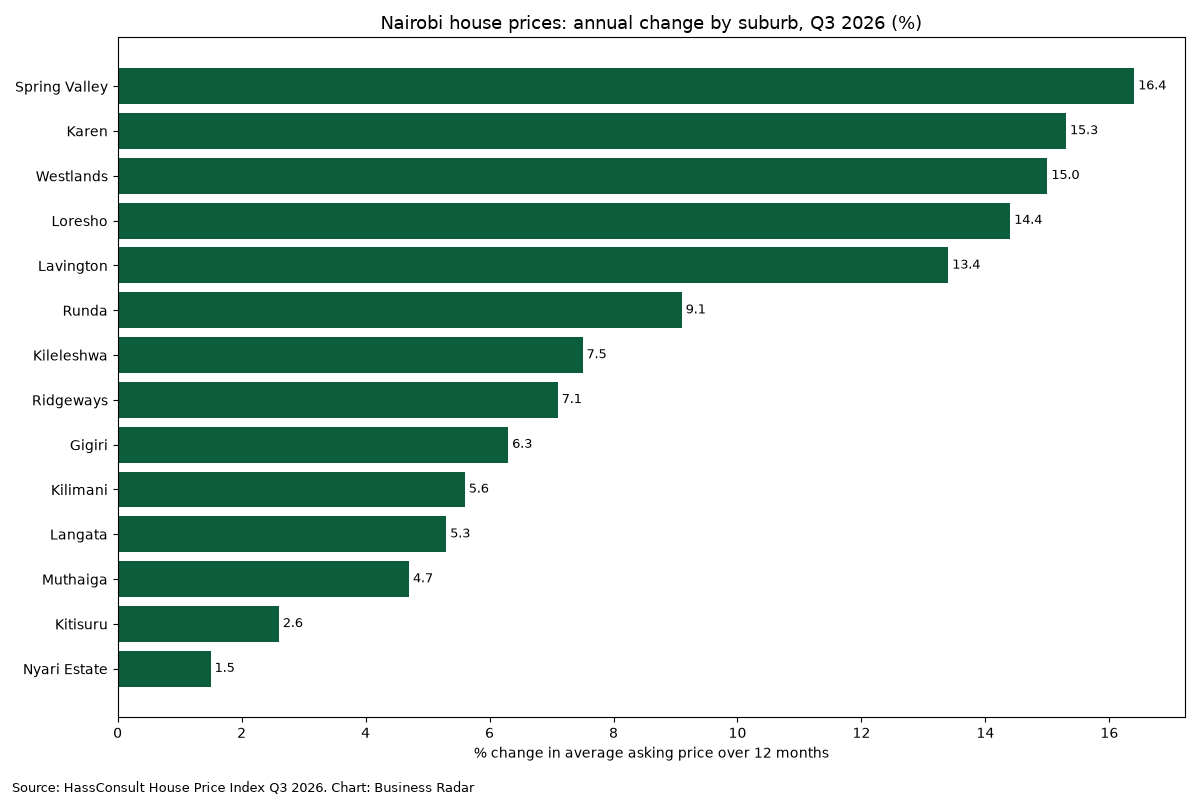
Over 12 months, Karen (15.3%), Westlands (15.0%), Loresho (14.4%) and Lavington (13.4%) followed Spring Valley. At the other end, house prices in Nyari Estate rose only 1.5% and Kitisuru 2.6%.
Apartments lagged behind houses
Flats tell a different story. Westlands apartments fell 2.2% in the quarter and 6.4% over the year, Parklands fell 2.4% and 3.7%, and Riverside and Upper Hill also slipped in the quarter. Muthangari was the strong spot, up 10.7% over the year.
These are the same areas where developers are filing the most new towers. Our report on new buildings in Nairobi counts ten large filings with NEMA in Westlands, Parklands and nearby areas since August, with about 4,430 homes or hotel keys. More flats competing for buyers keeps a lid on prices.
Rents climbed fastest in the northern suburbs
Suburban rents rose 2.7% in the quarter, up from 1.4% in the second quarter. HassConsult says that is close to the strongest quarterly rise in three years. The biggest increases were in Loresho, up 6.2% to an average of KSh 338,100 a month for a house, Kitisuru (5.1%, KSh 350,100), Muthaiga (4.5%, KSh 370,900) and Gigiri (3.9%, KSh 402,100).
HassConsult co-CEO Sakina Hassanali linked that to the expansion of United Nations operations and the gradual move of staff to Nairobi, which adds demand in the diplomatic suburbs close to Gigiri.
Satellite towns slipped
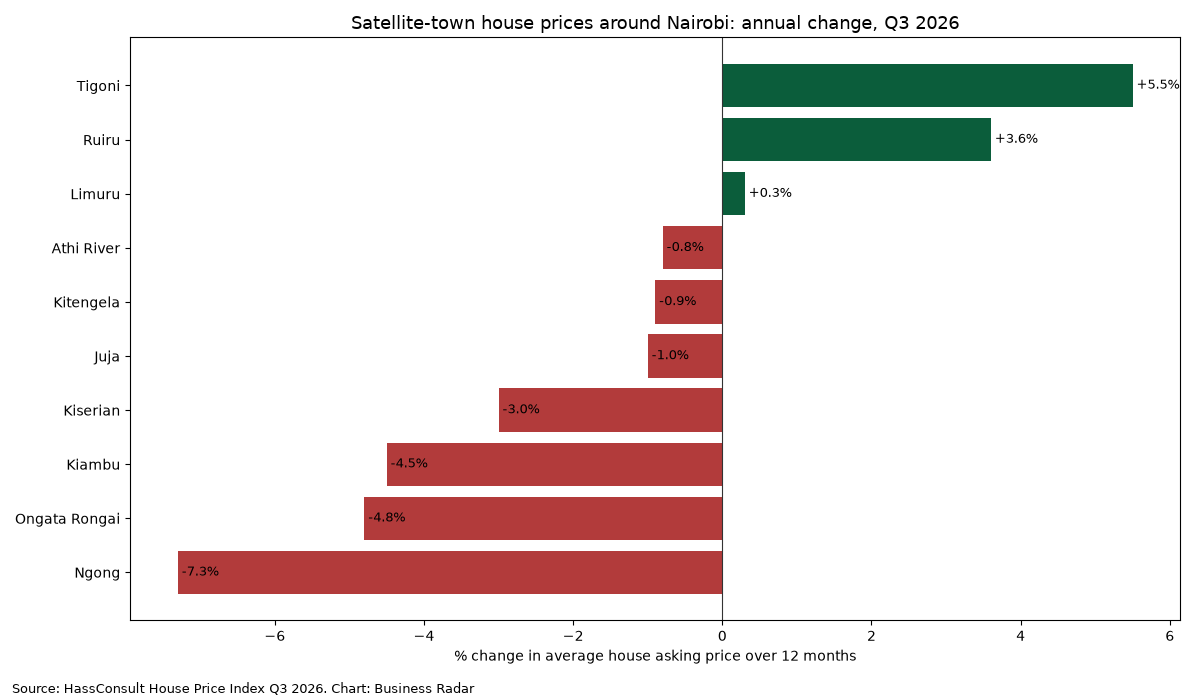
In the towns around Nairobi, house asking prices fell 1.2% in Ngong to KSh 19.1 million, 1% in Ongata Rongai to KSh 15.4 million, 0.6% in Juja to KSh 12.8 million and 0.5% in Kitengela to KSh 13.2 million. Over the year, Ngong houses are down 7.3% and Ongata Rongai down 4.8%. Tigoni (5.5%) and Ruiru (3.6%) were the main towns where house prices rose over the year.
Apartments were mixed. Syokimau flats rose 7.2% over the year and Kitengela 4.9%, but Ruaka fell 4.6% and Ongata Rongai 4.3%. For land, see our guide to land prices near Nairobi.
Why Nairobi house prices are moving
HassConsult points to cheaper credit. Citing Central Bank of Kenya data, it says average commercial bank lending rates fell from 17.2% in November 2024 to 14.4% in September 2026, and private-sector credit grew 10.6% in the year to September. In suburbs where few new houses are built, easier credit pushes prices up.
In satellite towns, the report says buyers are more sensitive to affordability and have more housing to choose from, so prices have not followed. If you are buying, compare lenders on our mortgage rates in Kenya page and check the official national picture in our story on the KNBS house price index.
What it means for buyers, sellers and landlords
Buyers in the suburbs are paying more for houses, but apartments in Westlands and Parklands are getting cheaper, and more are on the way. If you want a flat there, there is room to negotiate, especially on off-plan units where the developer still has many to sell. Check the developer and the project before you pay a deposit.
Buyers in satellite towns face flat or falling asking prices in many towns. That can mean a better deal, but it can also mean a slower resale later. Look at the town’s trend over two years, not one quarter, and at the commute.
Landlords in the northern suburbs are seeing the strongest rent growth in years, while satellite-town rents are rising more slowly. Before you buy to let, compare the rent you expect with the full cost of the mortgage, using our rent vs buy calculator and mortgage calculator.
Frequently asked questions
Are Nairobi house prices rising in 2026?
In the established suburbs, yes. HassConsult’s Q3 2026 index shows average asking prices up 2.3% in the quarter and 5.2% over the year. In satellite towns they fell 0.6% in the quarter and 2.0% over the year.
What is the average house price in Nairobi?
The average asking price across HassConsult’s 18 established suburbs was KSh 33,884,830 in Q3 2026, covering houses and apartments. Across 14 satellite towns it was KSh 14,433,355.
Which Nairobi suburb has the fastest-rising house prices?
Spring Valley, where average house asking prices rose 6.8% in the quarter and 16.4% over the year to KSh 79.4 million.
Are these sale prices or asking prices?
Asking prices. Buyers often negotiate below them, so use the index to judge whether a price is in range and get a valuation before you commit.
Prefer WhatsApp? Follow Business Radar on WhatsApp
Weekly, free. We only use your email for this newsletter and you can unsubscribe in one click. Privacy policy.

