


Get breaking business news on WhatsApp
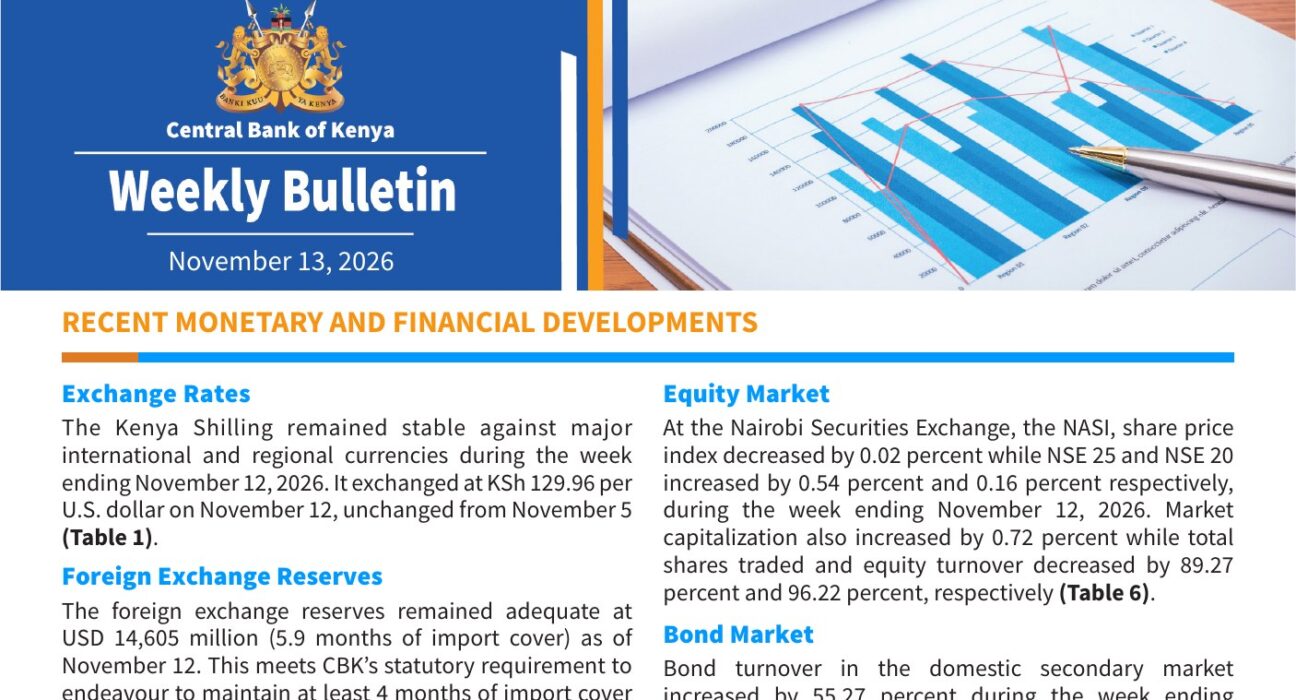
Kenya’s official forex reserves fell to USD14,605 million (about KSh1.9 trillion) on 12 November 2026, down USD94 million in a week and USD135 million from USD14,740 million on 29 October, according to the Central Bank of Kenya (CBK) weekly bulletin published on 13 November.
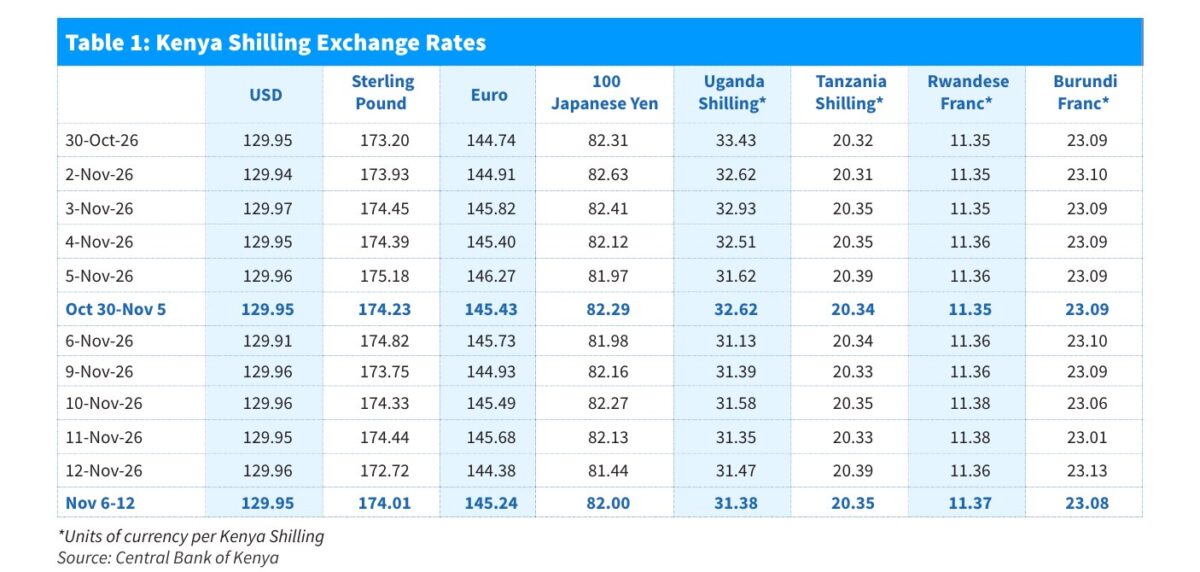
The forex reserves still cover 5.9 months of imports, unchanged over five weeks and above CBK’s statutory target of at least four months. The Kenya shilling held at KSh129.96 per US dollar on 12 November, the same as on 5 November.
On this page
Forex reserves: the five-week trend
| Date | Reserves (USD million) | Import cover (months) |
|---|---|---|
| 15 Oct 2026 | 14,689 | 5.9 |
| 22 Oct 2026 | 14,693 | 5.9 |
| 29 Oct 2026 | 14,740 | 5.9 |
| 5 Nov 2026 | 14,699 | 5.9 |
| 12 Nov 2026 | 14,605 | 5.9 |
The 12 November forex reserves figure is the lowest of the five weeks shown. The week’s USD94 million drop is about KSh12.2 billion at the current rate. CBK bases import cover on a 36-month average of imports of goods and non-factor services.

Shilling, remittances and money markets
The shilling traded in a tight KSh129.91–129.97 range against the dollar between 30 October and 12 November. Against the pound it firmed to KSh172.72 on 12 November from KSh175.18 on 5 November, and against the euro to KSh144.38 from KSh146.27.
Diaspora remittances were USD430.5 million (about KSh55.9 billion) in October, down 1.9% from USD438.8 million a year earlier, as we reported in our October remittances story. Twelve-month inflows fell 1.1% to USD5,023 million.
Banks held excess reserves averaging KSh31.5 billion above the 3.25% cash reserve ratio. The overnight interbank rate, KESONIA, stayed at 8.75%, while average daily interbank trades rose to 23 from 16 and the average value traded rose to KSh13.4 billion from KSh9.2 billion.
Oil, gold and bond markets
Murban crude fell to USD90.07 a barrel on 12 November from USD94.04 on 5 November, which CBK linked to easing fears of a wider military escalation in the Middle East. Spot gold fell to USD3,876.4 an ounce from USD4,087.7. Oil prices feed into local pump prices; see EPRA fuel prices for November 2026.
Yields on Kenya’s Eurobonds rose an average of 2.85 basis points. Domestic bond turnover rose 55.27%, while government paper drew mixed demand: the 12 November Treasury bill sale drew KSh69.3 billion against KSh28 billion offered (see the T-bill results), but the 9 November switch bond took in only KSh3.8 billion of KSh10 billion (switch bond results).
NSE in the same week
While forex reserves fell, NSE market capitalisation rose 0.72% to KSh4,083.83 billion. Equity turnover fell 96.22% to KSh4.15 billion, compared with a week that included the Nedbank block trade in NCBA covered in our previous weekly report. The NASI eased 0.02%, while the NSE 25 rose 0.54% and the NSE 20 rose 0.16%.
Frequently asked questions
How much are Kenya’s forex reserves now?
USD14,605 million on 12 November 2026, about KSh1.9 trillion, equal to 5.9 months of import cover, according to CBK.
Why do forex reserves matter?
They help CBK meet external debt payments, cover imports and smooth sharp moves in the shilling. The law asks CBK to try to keep at least four months of import cover.
What is the shilling exchange rate?
KSh129.96 per US dollar on 12 November 2026, unchanged from a week earlier, according to CBK.
How often does CBK publish forex reserves data?
Weekly, in the CBK weekly bulletin, which is usually released on Fridays.
Prefer WhatsApp? Follow Business Radar on WhatsApp
We will email you a weekly money and business brief. We store your email (and your name, if you give one) for that purpose, under the Kenya Data Protection Act, 2019. You can unsubscribe at any time. Privacy policy.

