


Get breaking business news on WhatsApp
K-Unity Sacco can sell both pieces of land a defaulting borrower charged to it in Kiambu, but it must first issue fresh statutory notices, serve the borrower’s spouse and get new valuations, the High Court has ruled.
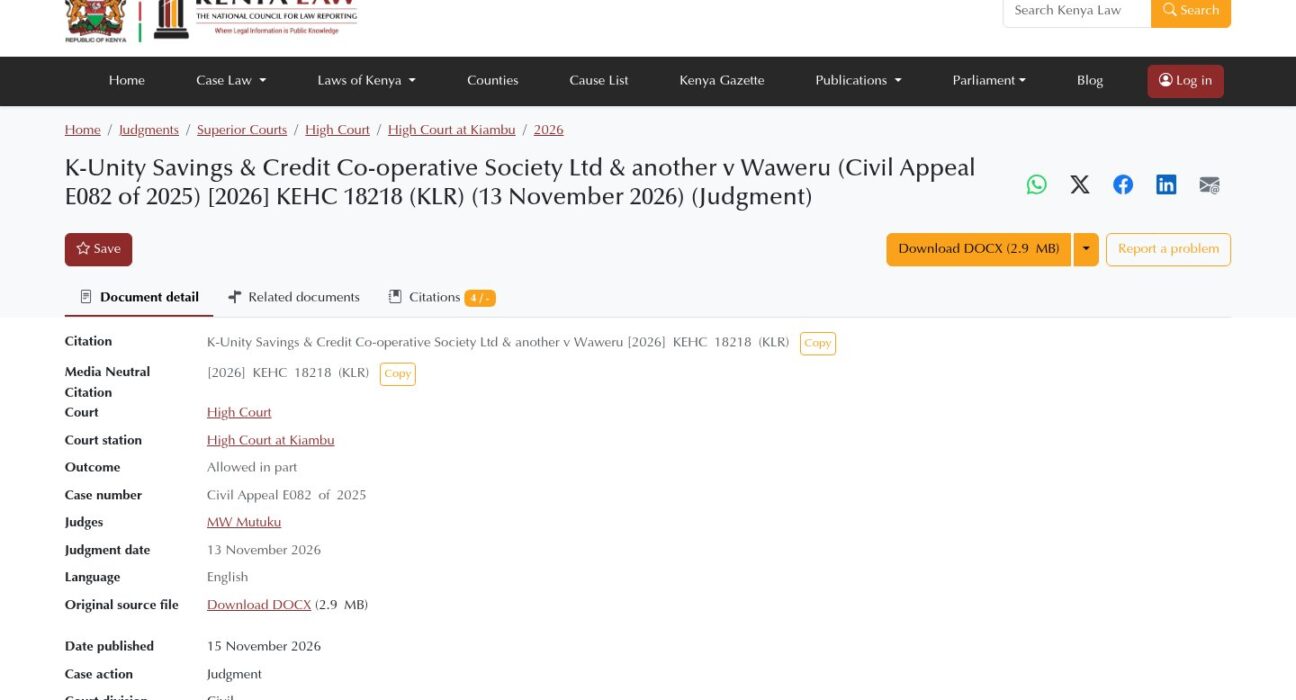
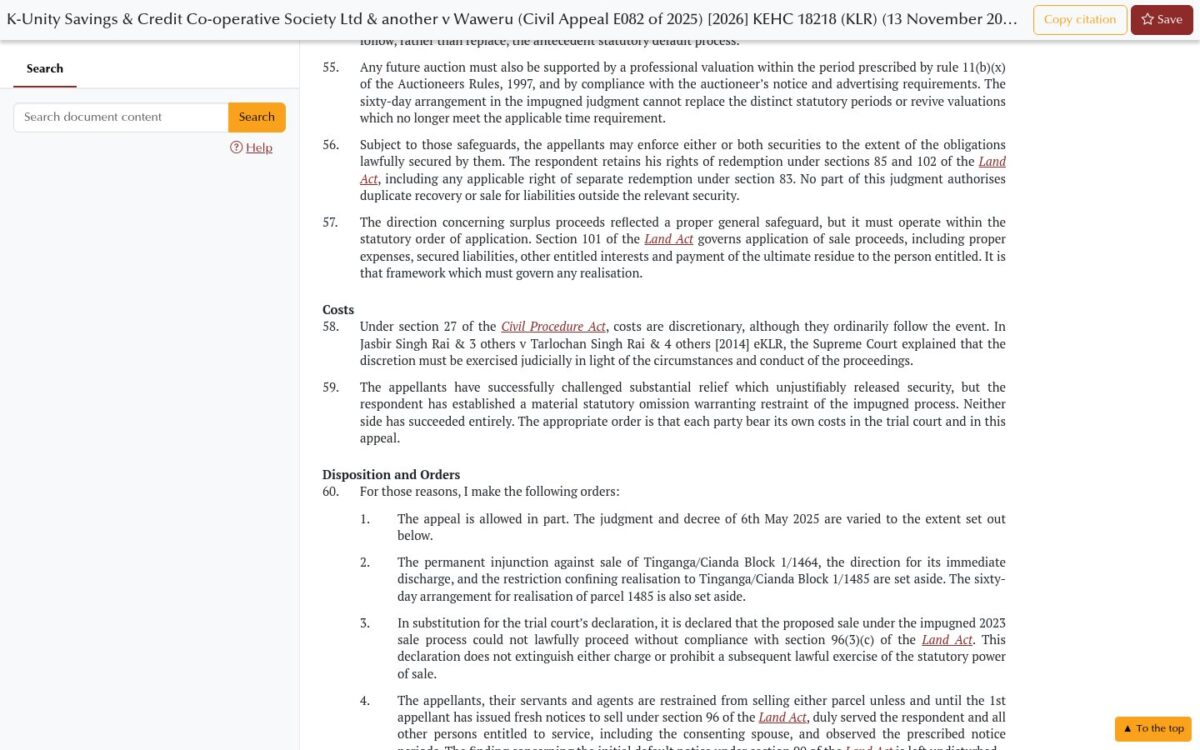
In a judgment delivered on 13 November 2026, Justice M.W. Mutuku of the High Court at Kiambu partly allowed an appeal by K-Unity Savings & Credit Co-operative Society Limited and Purple Royal Auctioneers against Dominic Stoney Waweru (Civil Appeal E082 of 2025). The court set aside a magistrate’s order that had permanently barred the sale of one of the plots and ordered it discharged.
On this page
How the K-Unity Sacco auction dispute started
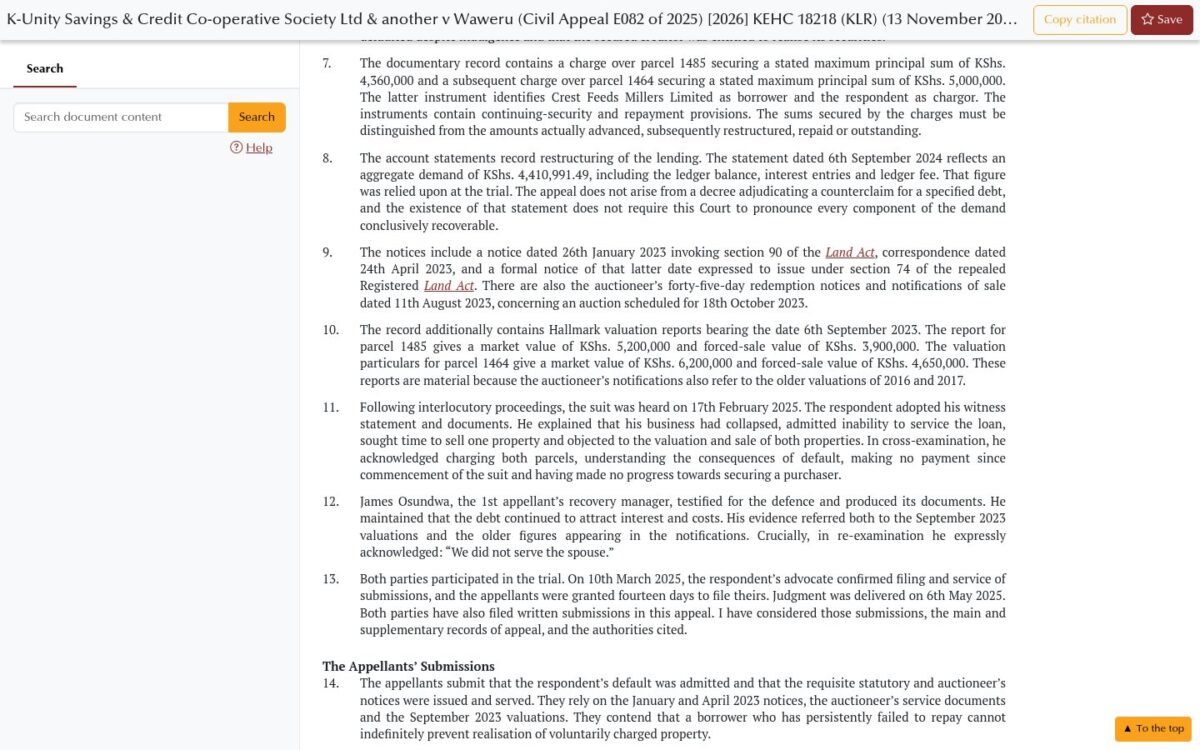
The borrower charged two parcels, Tinganga/Cianda Block 1/1485 and Block 1/1464, to secure loans. One charge secured a maximum principal of KSh4,360,000 and the other KSh5,000,000, with the second naming Crest Feeds Millers Limited as borrower. An account statement dated 6 September 2024 showed a demand of KSh4,410,991.49. The auctioneer’s notices set a sale for 18 October 2023.
Valuation reports dated 6 September 2023 gave parcel 1485 a market value of KSh5,200,000 (forced sale KSh3,900,000) and parcel 1464 a market value of KSh6,200,000 (forced sale KSh4,650,000). The borrower told the trial court his business had collapsed and he could not service the loan.
On 6 May 2025, a Kiambu magistrate declared the sale of parcel 1464 unlawful, permanently restrained it and ordered its discharge, while allowing the Sacco to sell only parcel 1485 after 60 days.
The missed step: serving the spouse
The High Court found the Sacco had not complied with section 96(3)(c) of the Land Act, which requires a copy of the notice to sell to be served on a spouse who consented to the charge. The Sacco’s recovery manager, James Osundwa, admitted in re-examination: “We did not serve the spouse.”
But the judge said the magistrate was wrong to release one security while the debt remained unpaid. The forced-sale value of parcel 1485, KSh3,900,000, was below the KSh4.41 million demand, so the court could not safely conclude that one plot would clear the debt.
What K-Unity Sacco must do before any sale
The court restrained the sale of either plot until the Sacco issues fresh notices under section 96 of the Land Act, serves the borrower and the consenting spouse, and gets a fresh valuation of each plot that complies with section 97 and the 12-month rule in the Auctioneers Rules. After that, the Sacco may sell either or both plots, but only to recover what the charges lawfully secure, and must account for any surplus. Each side bears its own costs.
What it means for Sacco borrowers
The ruling confirms that admitted default does not let a lender skip statutory steps, and that a court will not rewrite a charge by freeing a security while money is still owed. Members can check their numbers with our K-Unity Sacco loan calculator or reach the lender through the K-Unity Sacco contacts. Before buying land at auction, read our land fraud checklist.
Frequently asked questions
Can K-Unity Sacco sell the borrower’s land?
Yes, either or both plots, but only after issuing fresh section 96 notices, serving the consenting spouse and obtaining fresh valuations.
Why was the 2023 auction stopped?
The Sacco did not serve the borrower’s spouse, who had consented to the charge, with the notice to sell, as section 96(3)(c) of the Land Act requires.
How much did the Sacco demand?
KSh4,410,991.49, according to an account statement dated 6 September 2024.
Who pays the costs?
Each party bears its own costs in the trial court and the appeal.
Prefer WhatsApp? Follow Business Radar on WhatsApp
We will email you a weekly money and business brief. We store your email (and your name, if you give one) for that purpose, under the Kenya Data Protection Act, 2019. You can unsubscribe at any time. Privacy policy.

