


Get breaking business news on WhatsApp
The Rironi–Mau Summit highway accounts for KSh180.73 billion of the KSh413.81 billion the government could owe private investors if every signed public-private partnership (PPP) deal were cancelled early in the 2027/28 financial year, the National Treasury says.
The figures are in a fiscal risk annex to the Draft 2027 Budget Policy Statement, published this month. The Treasury lists each PPP project’s maximum contingent liability, which is the most the state could have to pay mainly in termination compensation if a project agreement ended early.
Two highway contracts, one corridor
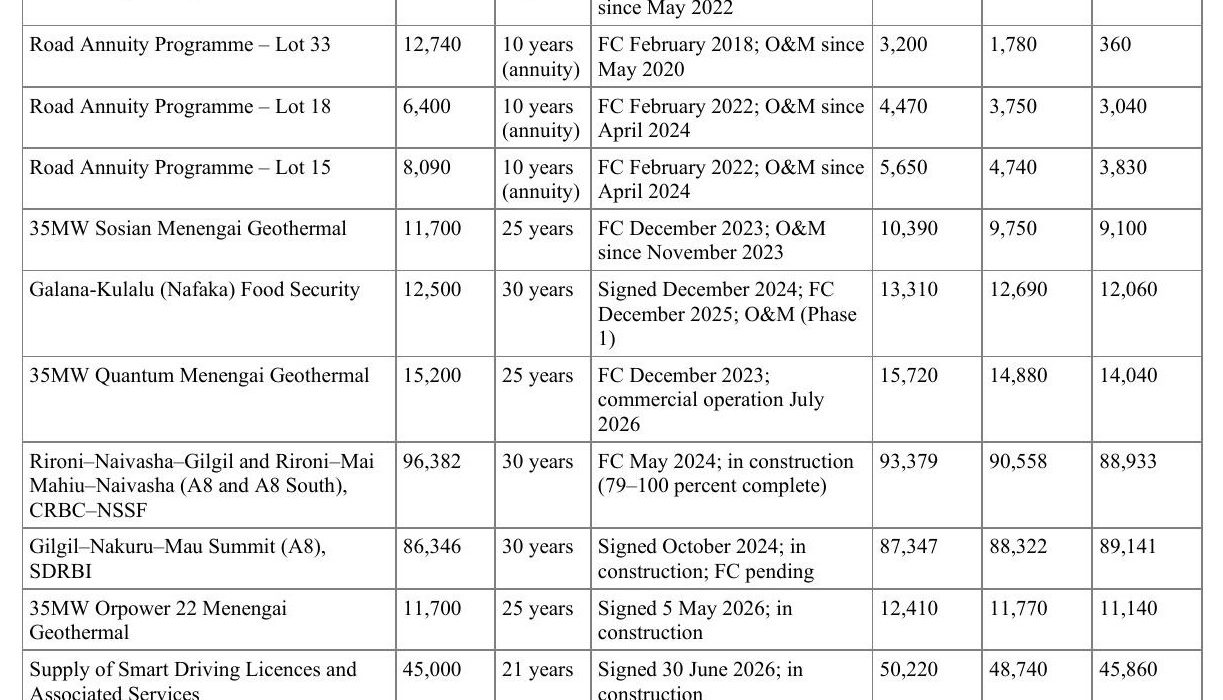
The highway is split into two concessions. The Rironi–Naivasha–Gilgil and Rironi–Mai Mahiu–Naivasha sections (A8 and A8 South), held by CRBC and NSSF, carry a maximum exposure of KSh93.38 billion in 2027/28. The project is valued at KSh96.38 billion, runs for 30 years and reached financial close in May 2024. The Treasury describes it as “in construction (79–100 percent complete).”
The Gilgil–Nakuru–Mau Summit section, listed under SDRBI, carries KSh87.35 billion. It is valued at KSh86.35 billion, was signed in October 2024 and is in construction with financial close still pending.
Together the two sections make up about 44% of the exposure from signed PPP agreements. The rest is spread across 11 other projects, led by the Nairobi Expressway at KSh72.04 billion, the smart driving licences contract at KSh50.22 billion and the Africa50/PowerGrid transmission lines at KSh41.05 billion.
In July the Treasury said the current highway agreements were signed in May and June 2026 after the earlier availability-payment concession was terminated. It said the new user-pay toll model “transfers demand and revenue risk to the private sector” and cuts the comparable investment cost to USD 1.342 billion (KSh173.5 billion) from USD 1.93 billion.
Not an expected bill
The Treasury stresses that the totals are worst-case figures. “The likelihood, value and timing of termination payments cannot be determined with certainty in advance, and it is unlikely that all projects would be terminated at the same time,” the document says.
Applying a 6% probability of early termination, drawn from World Bank research on PPP cancellations, it puts the expected liability at KSh89.3 billion, or 0.4% of GDP, in 2027/28. That probability is applied to a much larger portfolio total of KSh1.49 trillion, which includes projects that have not yet reached commercial close.
The pipeline is bigger than the signed book
Approved projects still in the pipeline would add KSh1.07 trillion of maximum exposure in 2027/28 on the Treasury’s estimates. The largest single item is the planned Nairobi–Mombasa Expressway at KSh467 billion, followed by the Mau Summit–Eldoret–Malaba road at KSh202.8 billion and two phases of KPA port assets at KSh96 billion each. A proposed Kibuka (High Grand) Falls hydropower and irrigation dam would add KSh404 billion from 2029/30.
The Treasury is proposing a cap on total PPP contingent liabilities equal to 10% of nominal GDP, or about KSh2.31 trillion in 2027/28, rising to KSh2.54 trillion in 2029/30. On its projections, the full portfolio would reach about 8.9% of GDP by 2029/30, leaving headroom of roughly KSh270 billion.
“As this headroom is limited, further projects will be admitted against the limit in order of priority,” the document says. It adds that any payment arising from a contingent liability that crystallises “shall be provided for in the budget Estimates and submitted to Parliament for approval.”
The draft also says KSh55 billion of private capital was mobilised through PPPs in 2025/26, the 30% equity share of an expected KSh183 billion private investment in the Rironi–Mau Summit road projects. The same budget paper earlier set out the government’s spending plans for 2027/28, and the Treasury is separately seeking a private partner for the Konza data centre.
Prefer WhatsApp? Follow Business Radar on WhatsApp
Weekly, free. We only use your email for this newsletter and you can unsubscribe in one click. Privacy policy.

