


Updated 28 October 2026
Avocado export Kenya rules require three things to be in place: a horticultural export licence from the Agriculture and Food Authority’s Horticultural Crops Directorate (AFA-HCD), registration as an exporter with KEPHIS, and a KEPHIS phytosanitary certificate for every consignment. KEPHIS charges KSh500 plus KSh0.50 per kg to inspect fresh produce and KSh500 to issue the certificate. Growers, packhouses and transport are all inspected before you are approved. This guide lists the documents, fees and steps, and the checks that sink first-time exporters.
Updated October 2026, from the KEPHIS Service Charter, the KEPHIS procedure for registration as an exporter and the HCD exporter registration checklist.
Who Regulates Avocado Export in Kenya?
| Body | What it controls | What you get |
|---|---|---|
| AFA Horticultural Crops Directorate (HCD) | Who may trade and export horticultural produce | Export licence |
| KEPHIS (Kenya Plant Health Inspectorate Service) | Plant health and market requirements, pesticide residues | Exporter registration and phytosanitary certificate |
| KRA Customs | Export declaration | Customs clearance, usually through an agent |
AFA also announces export seasons and suspensions for avocado varieties to protect quality, so check its current notices before you sign buyer contracts.
Step 1: Get the HCD Export Licence
The HCD checklist for new exporters asks for:
- Certified certificate of business registration and memorandum and articles of association.
- KRA PIN and a certified tax compliance certificate.
- ID copies of all directors (passport and work permit for foreign directors).
- Written evidence from an overseas client that you are ready to start exporting.
- A county business permit and the typed application forms.
HCD then inspects every farm you source from, your packhouse and your transport. It asks for farmer details, contracts with contracted growers witnessed by HCD, a working farm-to-packhouse traceability system and a declaration of your clearing and forwarding agent. Confirm the current licence fee with AFA when you apply, as the published checklist predates the current regulations.
Step 2: Register With KEPHIS as an Exporter
Apply in writing to the KEPHIS Managing Director with your HCD export licence, company registration certificate, KRA PIN, directors’ IDs, any grower contracts and details of farm locations, crops, acreage and target market. KEPHIS runs a systems audit within ten working days covering:
- Farmer recruitment, pest management and approved pesticide lists.
- Calibrated spray equipment, trained sprayers and spray records.
- Traceability, internal audits and handling of non-conformities.
- Hygiene of produce and handlers, storage of chemicals and waste disposal.
- Technical staff with at least tertiary training in agriculture or horticulture.
Fresh fruit dealers must also submit a produce sample for pesticide residue testing at the KEPHIS laboratory after a successful field audit.
Avocado Export Kenya Fees at KEPHIS
| KEPHIS service | Fee | Turnaround |
|---|---|---|
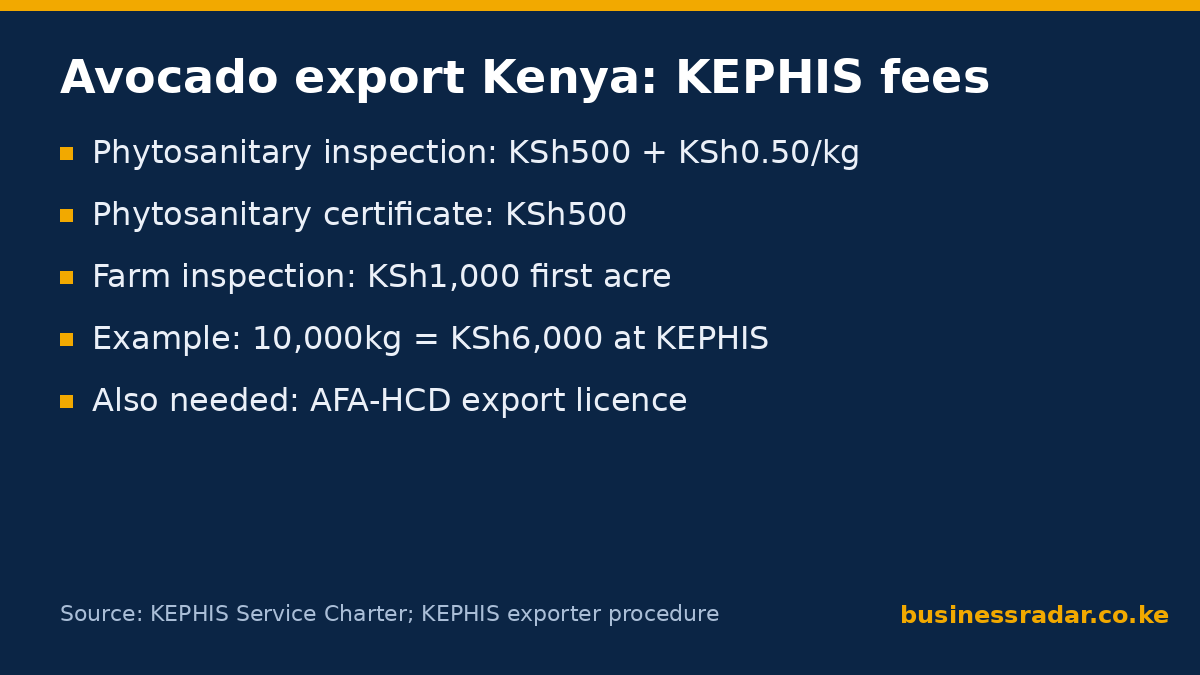
| Exporter registration: farm inspection | KSh1,000 for the first acre, KSh250 per extra hectare, plus KSh90.55 per km mileage | 2 weeks |
| Phytosanitary inspection, fresh produce | KSh500 plus KSh0.50 per kg | 3 hours |
| Phytosanitary certificate issue | KSh500 | 3 hours |
| Certificate replacement or amendment | KSh1,000 each | 3 hours |
Worked example: a 10,000kg consignment costs KSh500 + (10,000 x KSh0.50) = KSh5,500 to inspect, plus KSh500 for the certificate, so KSh6,000 at KEPHIS before freight, packaging and agent fees.
Step 3: Ship Each Avocado Export Kenya Consignment
- Harvest only mature fruit; maturity is checked before export.
- Pack at your registered packhouse with traceability codes.
- Book the KEPHIS inspection, presenting the consignment and commercial invoice.
- Collect the phytosanitary certificate and lodge the export entry through your agent.
Cold-chain capacity is growing: see the EU-backed Naivasha cold-chain hub for fruit exports. Choosing an agent? Read how clearing and forwarding licences work.
Mistakes That Cost Exporters
- Buying fruit from farms that HCD never inspected, which breaks traceability.
- Skipping spray records; residue failures can lead to interceptions abroad.
- Ignoring price swings. Tree crops can slump fast, as Kakuzi’s macadamia warning showed.
Thinking of other crops? Compare hydroponic farming suppliers or Irish potato farming.
Is Avocado Export Kenya Business Right for You?
The paperwork is the easy part. Avocado export Kenya businesses succeed or fail on supply: enough mature, residue-free fruit from inspected farms, packed to the buyer’s specification every week of the season. Start small, perhaps by consolidating for an established exporter, learn the audits, then apply for your own licence once you have reliable growers and a buyer who pays on time.
Official Sources
- KEPHIS Service Charter, phytosanitary fees (PDF)
- KEPHIS: Procedure for registration as an exporter (PDF)
- HCD exporter registration checklist (PDF)
Frequently Asked Questions
What licence do I need to export avocados from Kenya?
A horticultural export licence from AFA’s Horticultural Crops Directorate, plus registration with KEPHIS as an exporter.
How much is a KEPHIS phytosanitary certificate?
KSh500 to issue, after an inspection that costs KSh500 plus KSh0.50 per kg for fresh produce.
How long does KEPHIS exporter registration take?
The KEPHIS charter gives two weeks, and the systems audit is done within ten working days of the application.
Can I export avocados without my own farm?
Yes, by sourcing from contracted growers, but HCD inspects every source farm and wants signed, witnessed contracts.
Checked on 28 October 2026 against the KEPHIS Service Charter (reviewed 2024), the KEPHIS exporter registration procedure and the HCD exporter checklist.
Prefer WhatsApp? Follow Business Radar on WhatsApp
Weekly, free. We only use your email for this newsletter and you can unsubscribe in one click. Privacy policy.

