



Get breaking business news on WhatsApp
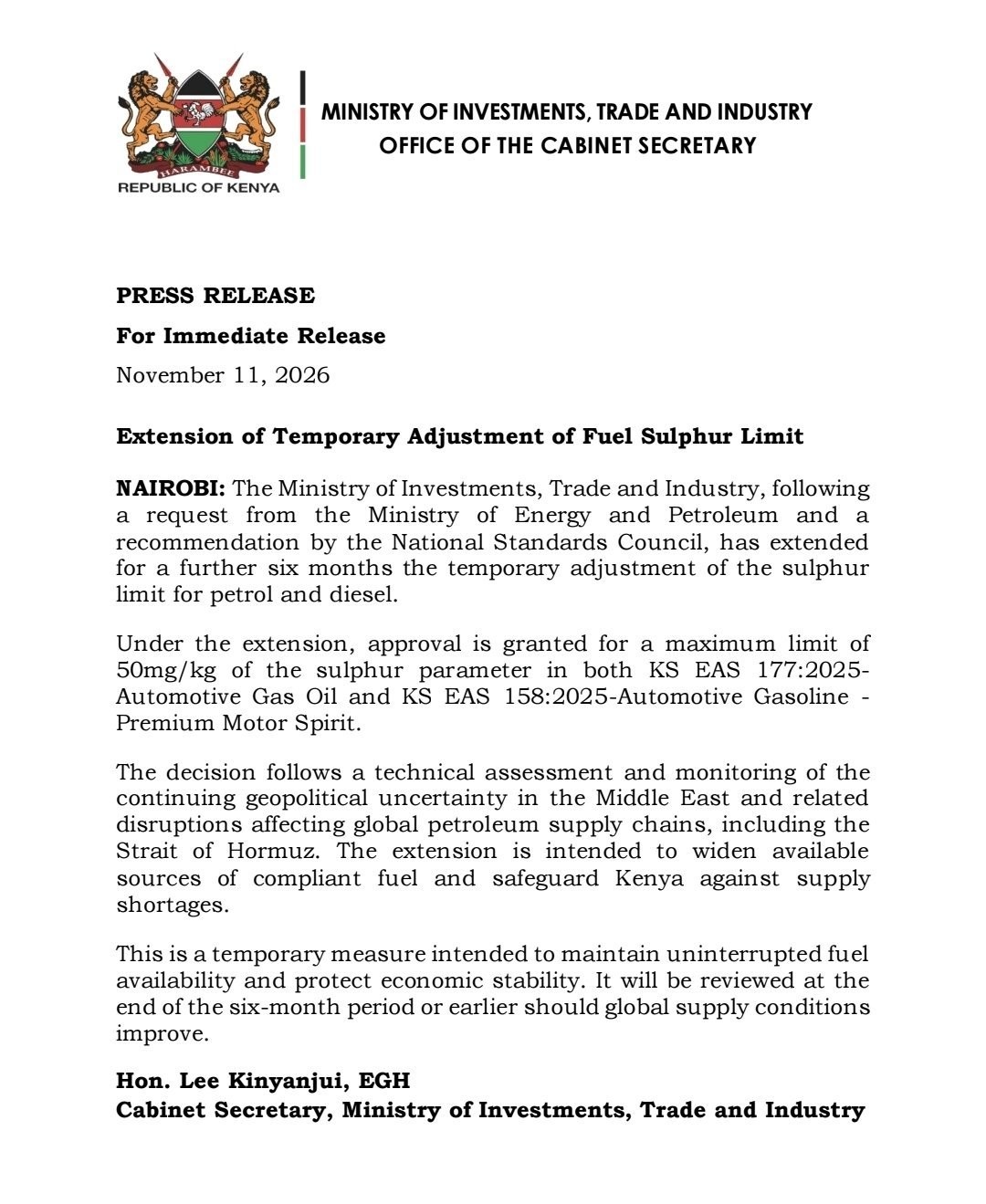
Kenya has extended its temporary fuel sulphur limit of 50mg/kg for petrol and diesel by a further six months, the Ministry of Investments, Trade and Industry said on 11 November 2026, citing continuing disruption to oil supply routes in the Middle East. The decision keeps the door open to fuel cargoes that do not meet the stricter sulphur level in the current standards.
Cabinet Secretary Lee Kinyanjui said the ministry acted on a request from the Ministry of Energy and Petroleum and a recommendation by the National Standards Council.
On this page
What the fuel sulphur limit extension covers
The press release says approval is granted “for a maximum limit of 50mg/kg of the sulphur parameter” in two Kenyan standards: KS EAS 177:2025 for automotive gas oil (diesel) and KS EAS 158:2025 for premium motor spirit (petrol).
The ministry said the decision “follows a technical assessment and monitoring of the continuing geopolitical uncertainty in the Middle East and related disruptions affecting global petroleum supply chains, including the Strait of Hormuz.” The extension is meant “to widen available sources of compliant fuel and safeguard Kenya against supply shortages.”
How the fuel sulphur limit waiver started
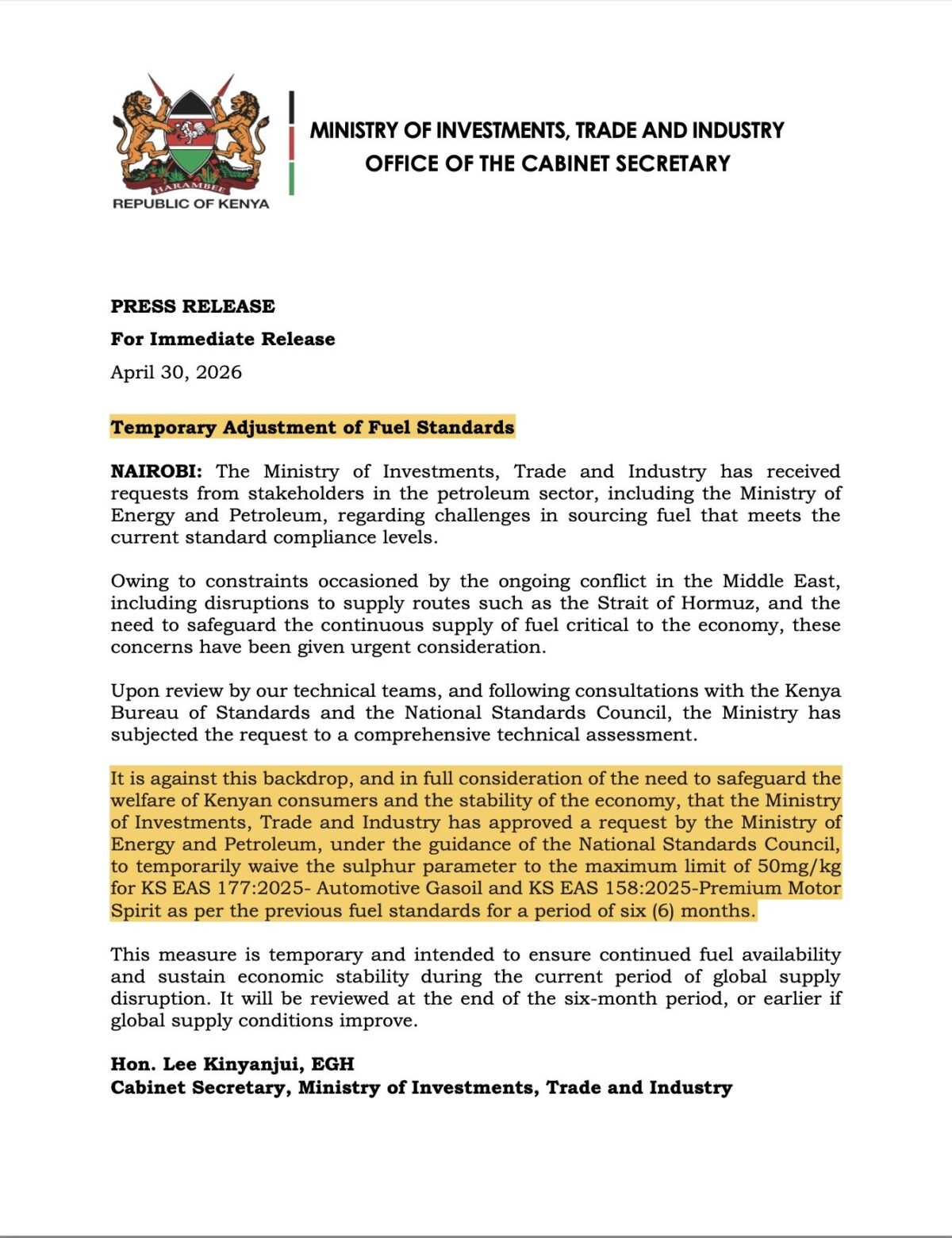
The first waiver was announced on 30 April 2026. In that release, the ministry said it had received requests from stakeholders in the petroleum sector, including the energy ministry, “regarding challenges in sourcing fuel that meets the current standard compliance levels.” After consulting the Kenya Bureau of Standards and the National Standards Council, it allowed the 50mg/kg limit “as per the previous fuel standards for a period of six (6) months.”
The new release does not give exact start and end dates for the extra six months. It says the measure “will be reviewed at the end of the six-month period or earlier should global supply conditions improve.”
What it means for motorists and fuel prices
The ministry describes the move as a way “to maintain uninterrupted fuel availability and protect economic stability.” It did not say whether the waiver affects pump prices. The Energy and Petroleum Regulatory Authority sets those each month, and the current caps are in our report on EPRA fuel prices to 14 November, with the next review due on 14 November.
Supply worries linked to the Middle East have been building since earlier this year, as covered in our story on fuel supply during the Iran crisis. Tax is the other big part of the pump price, set out in our report on the tax bill, fuel VAT and excise changes. You can work out what a trip costs with our fuel cost calculator.
Frequently asked questions
What is Kenya’s current fuel sulphur limit?
Under the extended waiver, petrol and diesel may contain up to 50mg/kg of sulphur under KS EAS 158:2025 and KS EAS 177:2025.
How long is the fuel sulphur limit extension?
A further six months, according to the 11 November 2026 release, which did not give exact dates. It will be reviewed at the end of the period or earlier if supply improves.
Why did Kenya extend the sulphur waiver?
The ministry cited disruption to global petroleum supply chains, including the Strait of Hormuz, and the need to widen sources of compliant fuel.
Who approved the sulphur waiver?
Investments, Trade and Industry CS Lee Kinyanjui, on a request from the Ministry of Energy and Petroleum and a recommendation by the National Standards Council.
Prefer WhatsApp? Follow Business Radar on WhatsApp
We will email you a weekly money and business brief. We store your email (and your name, if you give one) for that purpose, under the Kenya Data Protection Act, 2019. You can unsubscribe at any time. Privacy policy.

