


Updated 28 October 2026
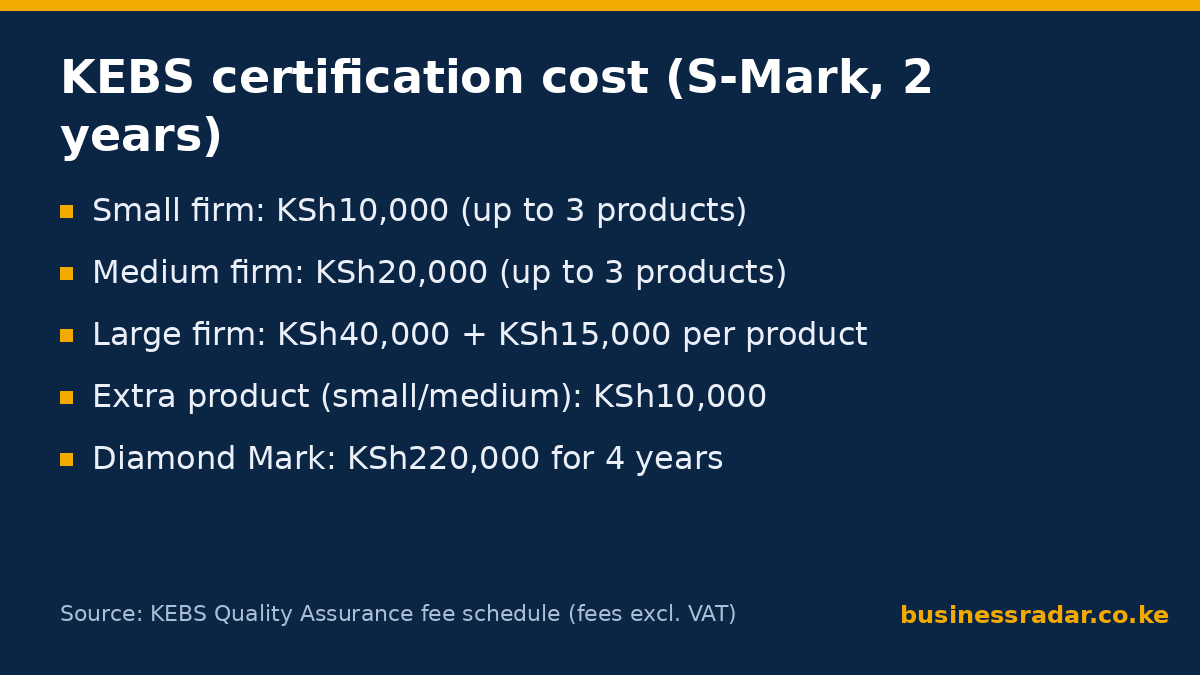
KEBS certification with the Standardization Mark (S-Mark) costs KSh10,000 for a small manufacturer, KSh20,000 for a medium one and KSh40,000 plus a KSh15,000 permit fee for a large one. Each permit runs for two years. Small and medium firms are covered for up to three products, then pay KSh10,000 for each extra product. You apply on the KEBS KIMS portal, KEBS inspects your premises and tests samples, and a permit is issued if the product meets the Kenya Standard. Below are the 2026 fees for all three marks, the turnover bands and each step.
Updated October 2026, from the KEBS Quality Assurance fee schedule and FAQs on qualityassurance.kebs.go.ke. KEBS states its fees exclude VAT.
Is KEBS Certification Mandatory?
For locally manufactured goods covered by a Kenya Standard, yes. KEBS describes the S-Mark as a mandatory product certification scheme under section 10 of the Standards Act (Cap 496). The permit certifies that a specific product meets an approved standard. KEBS enforces it: in 2026 it warned miraa drink makers of KSh1m fines after saying it had certified none of them.
KEBS Certification Cost: S-Mark Fees
| Firm category | Annual turnover (KEBS bands) | Inspection fee per site (2 years) | Permit fee (2 years) |
|---|---|---|---|
| Small (SME) | Up to KSh200,000 | KSh10,000 | Up to 3 products, then KSh10,000 per extra product |
| Medium (MME) | Over KSh200,000 up to KSh500,000 | KSh20,000 | Up to 3 products, then KSh10,000 per extra product |
| Large (LME) | Over KSh500,000 | KSh40,000 | KSh15,000 per product, brand or production site |
Example: a small juice maker certifying four flavours at one site would pay KSh10,000 plus KSh10,000 for the fourth product, KSh20,000 in total before VAT, for two years.
Diamond Mark and Fortification Mark Fees
| Mark | Fee | Validity |
|---|---|---|
| Diamond Mark (local firm) | KSh220,000 excl. VAT per product, brand or site | 4 years |
| Diamond Mark (external firm) | USD 16,000 plus inspector costs and travel | 4 years |
| Fortification Mark (any size) | KSh20,000 per product, brand or site | 2 years |
All KEBS payments go through eCitizen.
How to Get KEBS Certification, Step by Step
- Register on KIMS (kims.kebs.org) and follow the manufacturer application process.
- Upload documents and pay the certification fee on eCitizen.
- Buy the product standard (specification and codes of practice) from the KEBS Webstore so you know what you will be tested on.
- Review: KEBS checks the application and assigns an officer. No samples are needed at application.
- Factory visit: officers inspect your production process and controls, draw samples and agree a scheme of supervision.
- Testing: samples are analysed at KEBS or an accredited or designated laboratory. If they fail, you fix the problem and resubmit.
- Decision: if you comply, the permit is issued.
How Long KEBS Certification Takes
KEBS doesn’t publish one fixed turnaround for the whole process, because it depends on when the factory visit can be booked, how long laboratory tests take for your product and whether samples pass first time. The fastest applications are complete on KIMS, paid on eCitizen straight away, and come from makers who already own the relevant standard and have tested their own product against it. If samples fail, KEBS asks for corrective action and fresh samples, which adds time.
Before You Apply: A Small Maker’s Checklist
- Register the business name first; see how to check and reserve a business name on eCitizen.
- Get your county single business permit.
- Set up clean, separate production space. Inspectors assess premises as well as product.
- Keep batch records: ingredients, quantities, dates and test results.
- Bottled water has its own extra rules; see KEBS requirements for a water bottling business.
Once certified, let buyers find and verify you online. A simple product website on a .co.ke domain from Truehost (affiliate link) lets supermarket buyers and customers check your products and permit number.
Budgeting for KEBS Certification
The permit fee is only part of the bill. Set aside money for the product standard itself, lab-ready packaging and labels, and any changes the inspector asks for in your production area. Renew before the two years run out, because KEBS certification lapses with the permit and goods sold without a valid mark can be seized.
Official Sources
Frequently Asked Questions
How much does KEBS certification cost for a small business?
KSh10,000 for two years, covering up to three products at one site, plus KSh10,000 for each extra product. Fees exclude VAT.
How long is a KEBS S-Mark permit valid?
Two years. The Diamond Mark runs for four years.
Do I need samples when applying for KEBS certification?
No. KEBS officers draw samples during the factory visit.
Where do I pay KEBS fees?
On eCitizen. KEBS says all its payments must now go through the platform.
Fees checked on 28 October 2026 on the KEBS Quality Assurance fee schedule, Standardization Mark page and FAQs.
Prefer WhatsApp? Follow Business Radar on WhatsApp
Weekly, free. We only use your email for this newsletter and you can unsubscribe in one click. Privacy policy.

