


Updated 10 November 2026
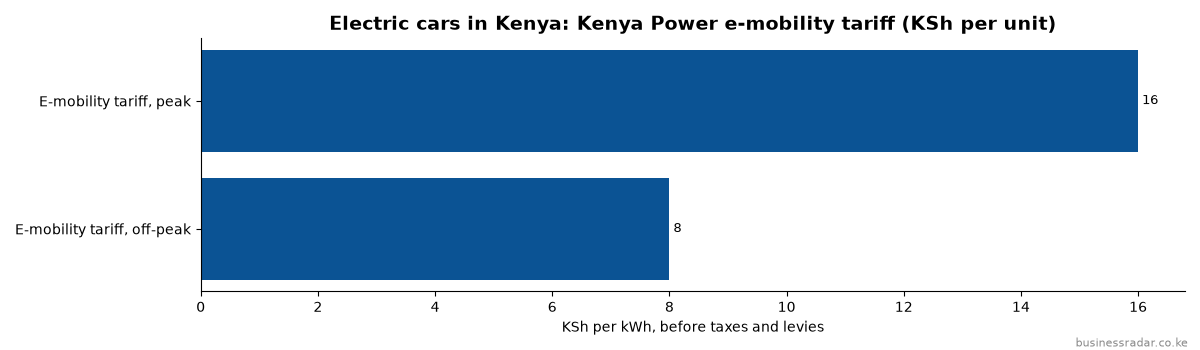
Owners of electric cars in Kenya can charge at a special Kenya Power rate of KSh 16 per unit (kWh) at peak times and KSh 8 per unit off-peak, but only if their charger is metered under the e-mobility tariff. Kenya Power says just 331 customers were on that tariff in June 2026, and it has started moving everyone who charges an electric vehicle onto it.
Based on Kenya Power’s notice of 4 June 2026, checked on 10 November 2026. Charging costs below are worked examples using the tariff rates; your bill can include other charges.
On this page
In this guide
The e-mobility tariff for electric cars in Kenya
The Energy and Petroleum Regulatory Authority (EPRA) approved a special electricity tariff for e-mobility in 2023, after a request from Kenya Power. Kenya Power started applying it in July 2023. The tariff charges KSh 16 per unit during peak hours and KSh 8 per unit during off-peak hours, which Kenya Power describes as a discounted rate.
The utility says the tariff also lets it see how much power the e-mobility sector uses, which it needs to plan for future demand. In June 2026 it began what it called an exercise to “mop up” customers who use electricity to charge electric vehicles and meter them under the e-mobility tariff.
Kenya Power’s managing director, Joseph Siror, said the transition “must serve not only private car owners, but also public transport, two and three wheelers, logistics operators, county transport systems, small businesses, and ordinary Kenyans.”
What charging an electric car costs
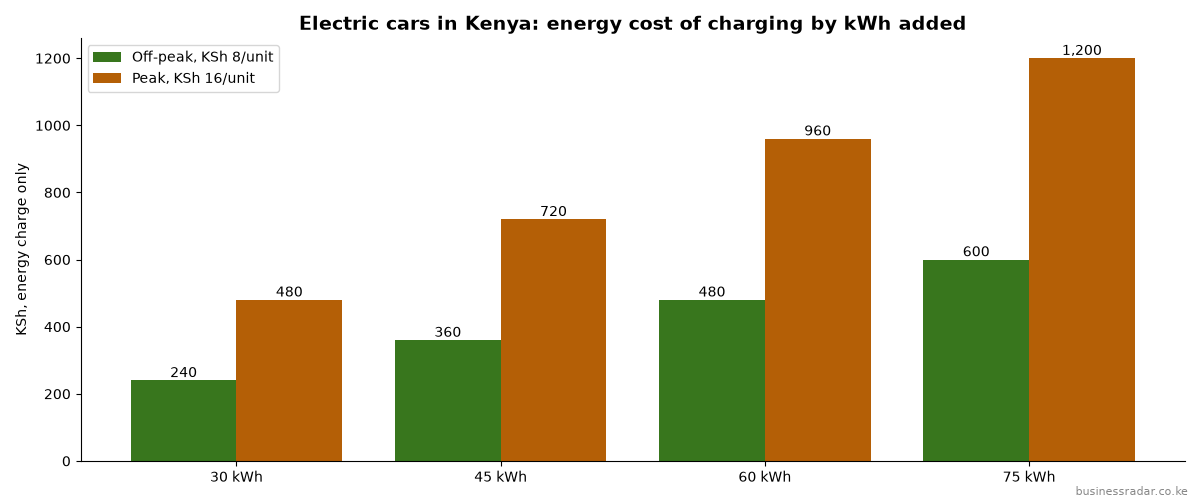
The energy part of a charge is simple to estimate: multiply the units (kWh) you put into the battery by the tariff rate. Off-peak charging costs half as much as peak charging, so most of the saving comes from charging overnight or at other off-peak times.
- Adding 30 kWh costs about KSh 240 off-peak or KSh 480 at peak.
- Adding 45 kWh costs about KSh 360 off-peak or KSh 720 at peak.
- Adding 60 kWh costs about KSh 480 off-peak or KSh 960 at peak.
- Adding 75 kWh costs about KSh 600 off-peak or KSh 1,200 at peak.
These figures are the energy charge only, at the tariff rates Kenya Power quotes. A charger loses some energy as heat, so you draw slightly more from the grid than reaches the battery. Check your car maker’s figures for battery size and range before you work out a cost per kilometre.
How many electric vehicles Kenya has
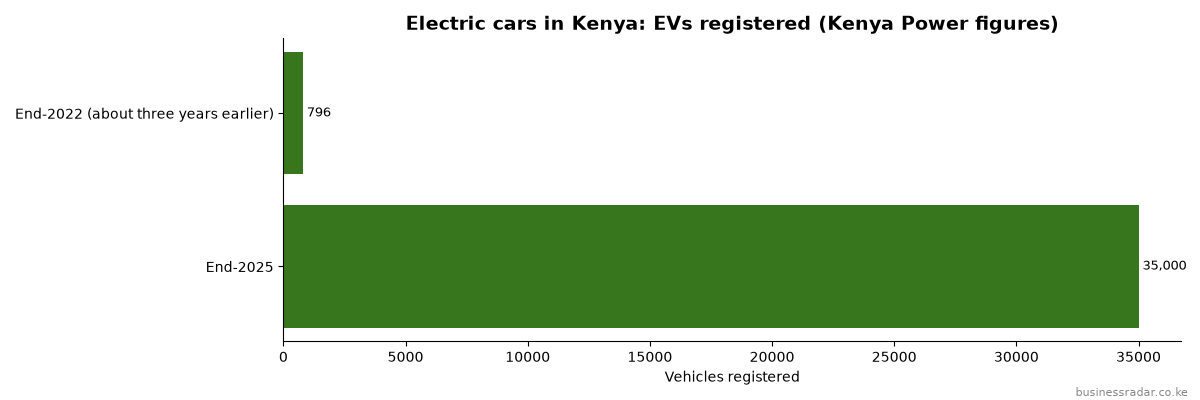
Kenya had registered more than 35,000 electric vehicles by the end of 2025, up from 796 three years earlier, according to Kenya Power. Most of them are two-wheelers, so electric cars in Kenya are still a small share of the total.
Charging demand has grown quickly. Kenya Power says its e-mobility electricity sales grew from 13,500 units to 1.5 million units over the 34 months after the tariff started, with revenue of KSh 382 million between July 2023 and April 2026. Monthly revenue peaked at KSh 35.25 million in February 2026. November 2025 was the first month that sales passed one million units, and Siror said volumes had stayed above that level since.
Nairobi produced KSh 271.9 million of the revenue, followed by Coast (KSh 55 million), North Eastern (KSh 35 million) and West Kenya (KSh 11.5 million). Kenya Power expects customers on the tariff to reach 1,000 by the end of the financial year. The Electric Mobility Association of Kenya (EMAK) estimates EV charging will generate KSh 5.79 billion in electricity sales by 2030.
Tax incentives on electric vehicles
Kenya Power lists the tax incentives behind the growth in EVs:
- a duty exemption on importing the first 100,000 EVs;
- zero-rating of VAT on EVs and lithium-ion batteries; and
- a reduced excise duty on electric bicycles, electric motorcycles and lithium-ion batteries.
If you plan to import a used electric car, check the KEBS eight-year rule first, and use our car import duty calculator to compare it with a petrol car. Confirm the current treatment of the vehicle with KRA before you ship it.
Buying an electric car in Kenya
Few brands publish electric car prices in Kenya. BYD, sold by CFAO Mobility, lists its models on its Kenyan website without a price list, so you need to ask for a quotation. Changan Kenya publishes a starting price of KSh 7.9 million for the Hunter K50 REEV 4WD, which it lists under its hybrid models. Our car prices in Kenya page lists every new vehicle with a price published by its official distributor.
Most buyers use asset finance. Compare lenders in our car loan interest rates table and work out the monthly cost with the car loan calculator. Ask your insurer whether it covers the battery and the home charger, and whether the premium differs from a petrol car of the same value.
How to get metered under the e-mobility tariff
Kenya Power’s notice does not set out an application form. If you charge an electric car at home or at your business, contact Kenya Power through its customer care email, customercare@kplc.co.ke, or its national contact centre on 0703 070 707 or 97771, and ask to be metered under the e-mobility tariff. Ask what wiring and meter changes are needed, who pays for them, and which hours count as peak and off-peak.
Fleet operators, charging station owners and businesses running electric motorcycles can ask for the same tariff. Kenya Power says it wants to bring public transport, logistics operators and county transport systems onto it as well. Our story on tax relief for electric farm motorcycles covers another part of the market.
Frequently asked questions
How much does it cost to charge an electric car in Kenya?
On Kenya Power’s e-mobility tariff, the energy costs KSh 8 per unit off-peak and KSh 16 per unit at peak. Adding 40 kWh costs about KSh 320 off-peak or KSh 640 at peak, before any other charges on the bill.
Is there a special electricity tariff for electric cars in Kenya?
Yes. EPRA approved an e-mobility tariff in 2023 and Kenya Power started applying it in July 2023. You need to be metered under it to get the rate.
How many electric vehicles are there in Kenya?
Kenya Power says more than 35,000 EVs had been registered by the end of 2025, most of them two-wheelers, up from 796 three years earlier.
Are electric cars exempt from import duty in Kenya?
Kenya Power lists a duty exemption on importing the first 100,000 EVs and zero-rated VAT on EVs and lithium-ion batteries. Confirm how your vehicle will be assessed with KRA before importing.
Prefer WhatsApp? Follow Business Radar on WhatsApp
Weekly, free. We only use your email for this newsletter and you can unsubscribe in one click. Privacy policy.

