


Quick answer
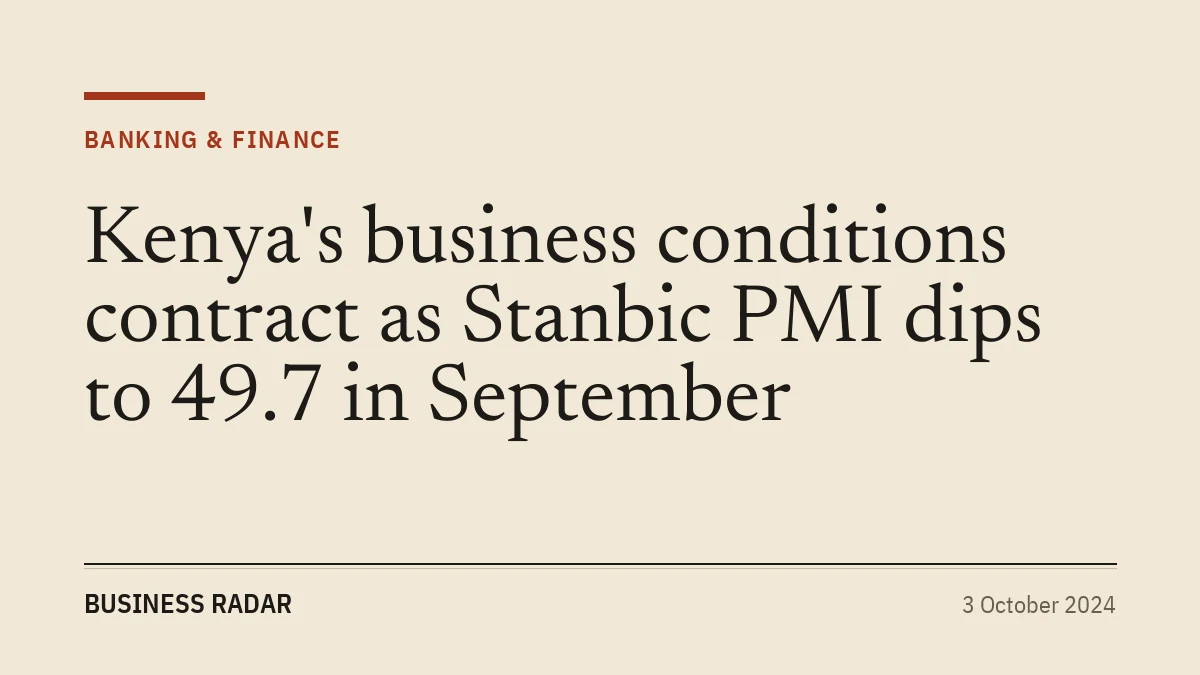
The Stanbic Bank Kenya PMI fell to 49.7 in September 2024 from 50.6 in August, signalling a slight deterioration. Output and new orders fell, employment was stable, input cost inflation eased and only 4% of firms expected growth over the next year.
Get breaking business news on WhatsApp
Business conditions in Kenya’s private sector weakened slightly in September 2024, as the Stanbic Bank Kenya Purchasing Managers’ Index (PMI) slipped to 49.7 from 50.6 in August. The reading, released on 3 October 2024 by Stanbic Bank and S&P Global, took the index back below the 50.0 mark that separates improvement from deterioration, only a month after it had recorded its first improvement in three months.
A PMI reading above 50.0 signals that business conditions improved on the previous month, while a reading below 50.0 signals a deterioration. The headline figure is built from monthly survey responses on new orders, output, employment, suppliers’ delivery times and stocks of purchases.
Output and new orders fall again
Surveyed firms reported a slight drop in activity at the end of the third quarter, alongside a renewed fall in new business. Respondents said economic pressure on both businesses and households, including weaker cash flow at clients, led to lower sales. The contraction was only marginal, and several panel members still reported better sales thanks to more customers, higher investment and marketing.
The picture differed by sector. New business fell in services, and contractions continued in agriculture and in wholesale and retail. Manufacturers and construction firms, on the other hand, reported higher sales.
| Indicator | August 2024 | September 2024 |
|---|---|---|
| Headline PMI | 50.6 | 49.7 |
| Output | Rising | Slight fall |
| New orders | Rising | Slight fall |
| Employment | Falling | Stable (index at 50.0) |
| Business outlook (firms expecting growth) | Subdued | 4% of firms |
Hiring steadies and stocks rise
Employment was stable in September, after falling in August. Firms said they had little need to hire new staff or replace workers who left, partly because pressure on their capacity eased and backlogs of work barely changed after several months of build-up.
Even with weaker demand, firms increased purchases of inputs for a second straight month. They said they were building stocks in the hope that sales would pick up in the final quarter. Inventories of inputs grew at the fastest pace since May, helped by slightly shorter supplier lead times.
Cost pressures ease
The slowdown brought some relief on prices. Purchase costs rose more slowly, producing the weakest increase in overall business expenses in four months of cost inflation. Because the rise in input costs was only marginal, companies raised their selling prices only mildly, mostly passing on higher costs where they had them.
Christopher Legilisho, an economist at Standard Bank, said the exchange rate and fuel prices had stayed unchanged over the previous two months, which was reflected in the survey. He expected inflation for September to be muted at about 4 to 4.5 percent.
Confidence at a ten-year low
The weakest part of the survey was the outlook. Only 4 percent of firms expected their activity to grow over the coming year.
“Business conditions contracted slightly in September, implying that the pickup in August was due to some recovery after the disruptions caused by protests earlier this year,” Legilisho said. “However, business expectations for the coming year remain at their weakest levels in a decade due to the economic headwinds of this year.”
He added that the stabilisation in employment and the rise in input buying and stocks suggested firms expected demand to improve in the fourth quarter of 2024.
What it meant for businesses
The September survey pointed to a private sector still recovering from the disruption of the mid-2024 anti-Finance Bill protests, which hit trade in June and July. A stable shilling and steady pump prices were keeping costs in check, but weak household spending was holding back sales, especially for retailers, farmers and service providers. Manufacturers and builders were the exception that month.
For small businesses, the PMI is a useful early signal because it is released at the start of each month, weeks before official GDP and inflation data. A run of readings below 50 usually means slower orders and tighter cash flow, while readings above 50 point to recovering demand.
For the latest reading, see our report on the Stanbic PMI for September 2026, and follow more updates in our economy section.
Frequently asked questions
What was Kenya’s PMI in September 2024?
The Stanbic Bank Kenya PMI fell to 49.7 in September 2024 from 50.6 in August.
What does a PMI below 50 mean?
A reading below 50.0 means business conditions deteriorated compared with the previous month.
Which sectors grew in September 2024?
Manufacturing and construction reported higher sales, while agriculture, wholesale and retail, and services saw declines.
Who publishes the Kenya PMI?
Stanbic Bank Kenya publishes it with S&P Global, based on a monthly survey of private sector purchasing managers.
Sources: Stanbic Bank Kenya PMI press release, 3 October 2024 (Stanbic Bank and S&P Global); Reuters via CNBC Africa, 3 October 2024.
Related: Kenya inflation rises to 7.3% in October, highest since July 2023
Prefer WhatsApp? Follow Business Radar on WhatsApp
Weekly, free. We only use your email for this newsletter and you can unsubscribe in one click. Privacy policy.

