


Get breaking business news on WhatsApp
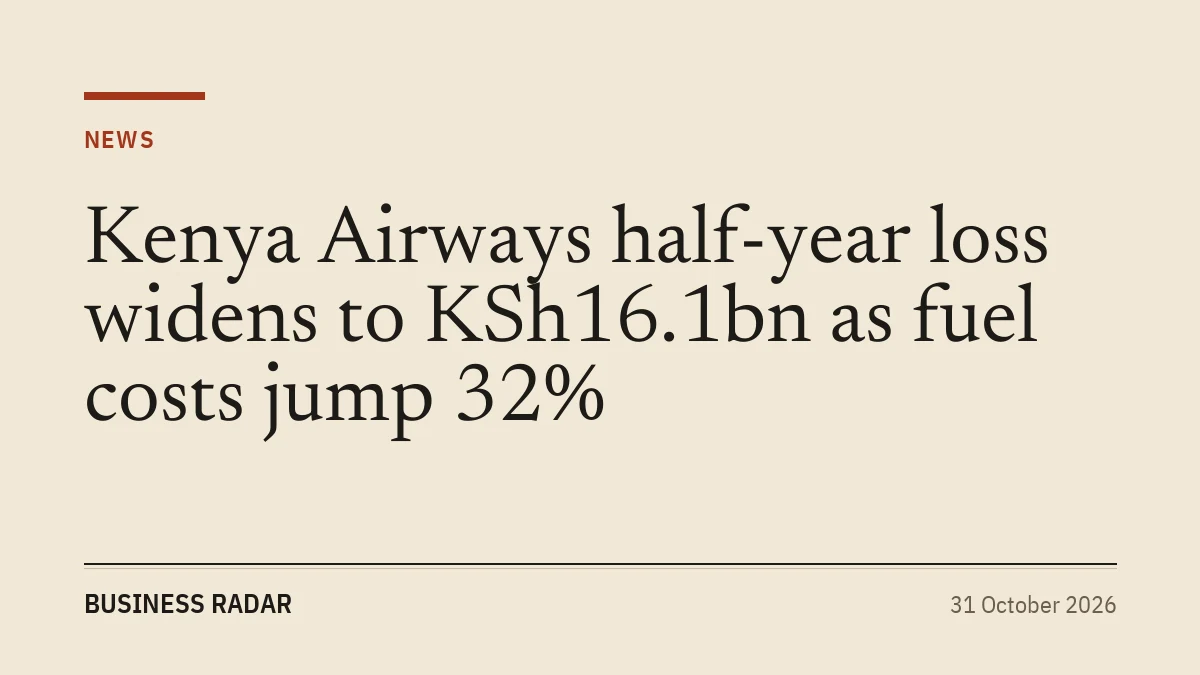
Kenya Airways (KQ) made a loss after tax of KSh16.1 billion in the six months to June 30, 2026, up from KSh12.2 billion in the same period of 2025, as higher jet fuel prices pushed total operating costs up 14%, according to the airline’s results press release and its published financial statement. Revenue still rose 9% to KSh81.3 billion, even though the airline flew 9% less capacity.
Kenya Airways H1 2026 key numbers
| Item (KSh million) | H1 2026 | H1 2025 |
|---|---|---|
| Total income | 81,254 | 74,504 |
| Total operating costs | (91,895) | (80,743) |
| Operating loss | (10,641) | (6,239) |
| Foreign exchange loss on borrowings and leases | (102) | (824) |
| Finance costs | (5,227) | (5,145) |
| Loss before tax | (15,923) | (12,173) |
| Loss for the period | (16,075) | (12,154) |
| Basic loss per share (KSh) | (2.75) | (2.09) |
| Cash generated from operations | 13,568 | 8,942 |
Source: Kenya Airways PLC summary financial statements for the six months ended June 30, 2026.
Why the loss widened: fuel
The airline said jet fuel prices rose 66% in the period because of geopolitical tensions in the Middle East. That lifted KQ’s fuel bill by 32% compared with the first half of 2025. Fuel made up about 32% of total operating expenses and 52% of direct operating costs.
Business Daily reported that chief financial officer Mary Mwega said that without the jump in fuel prices the loss would have stayed roughly at last year’s KSh12.2 billion level. The paper also cited IATA figures showing jet fuel in Africa peaked at about $220 a barrel in April before easing to about $150, still above historical averages.
Spare parts and fleet availability
The second pressure was the global aviation supply chain. KQ said shortages of critical spare parts, long lead times and delays in getting components disrupted fleet availability and reliability. This is the same problem that grounded part of its Boeing 787 Dreamliner fleet in 2025, which the airline has blamed for reduced operations and higher fleet ownership costs.
What went right
- Revenue up 9% to about KSh81 billion despite a 9% cut in capacity.
- Cabin factor improved by four percentage points, meaning planes flew fuller.
- Strong average fares (coupon values), according to the board’s statement.
- Cash from operations rose to KSh13.6 billion from KSh8.9 billion.
- Currency losses fell sharply, from KSh824 million to KSh102 million, helped by a stable shilling.
Balance sheet remains deeply negative
KQ’s statement of changes in equity shows total equity of negative KSh147.9 billion at June 30, 2026, compared with negative KSh132.1 billion at the end of 2025. Accumulated losses reached about KSh223 billion. In plain terms, the airline’s liabilities far exceed its assets, and it depends on government support and lenders to keep operating. Earlier in October the Cabinet approved a KSh45 billion lifeline to help restore grounded jets, as we reported.
What it means for shareholders and travellers
For NSE shareholders, a wider loss per share (KSh2.75 against KSh2.09) means no dividend is likely and the turnaround timeline gets longer. Profit depends heavily on fuel prices, which KQ does not control, and on getting grounded aircraft back in the air.
For travellers and businesses that rely on KQ, higher fuel costs usually show up as higher fares and fuel surcharges. Fuller planes also mean fewer last-minute seats on busy routes, so booking early matters more.
What to watch next
- Jet fuel prices in the second half of 2026 and whether Middle East tensions ease.
- How quickly the Cabinet-approved funds return grounded Dreamliners to service.
- Treasury’s supplementary budget, expected in November, which is set to include KQ funding.
- Full-year 2026 results, normally released in the first half of the following year.
Figures are from Kenya Airways’ official H1 2026 results. Business Radar does not give investment advice; check the NSE and the company’s investor page before buying or selling shares.
Prefer WhatsApp? Follow Business Radar on WhatsApp
Weekly, free. We only use your email for this newsletter and you can unsubscribe in one click. Privacy policy.

