


Get breaking business news on WhatsApp
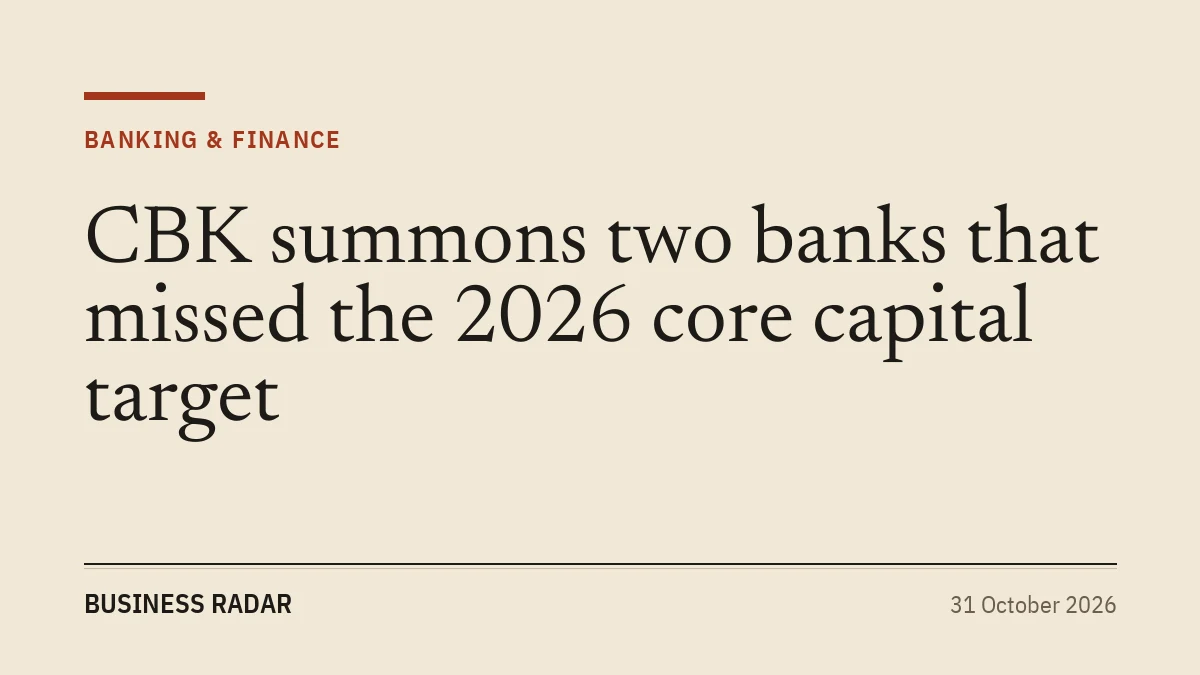
Two Kenyan commercial banks have fallen behind on the bank core capital target set for 2026, and the Central Bank of Kenya (CBK) will summon them to explain how they plan to raise the money, Governor Kamau Thugge told the National Assembly’s Finance Committee on October 31, 2026.
Thugge did not name the two lenders. He said the rest of the industry had made progress and stressed that stronger capital buffers are needed so banks can withstand shocks, including cyberattacks and climate-related losses, The Kenya Times reported.
What are the bank core capital rules in Kenya?
An amendment to the Banking Act raised the minimum core capital for commercial banks from KSh1 billion to KSh10 billion. Core capital is essentially shareholders’ money plus retained earnings: the cushion that absorbs losses before depositors are hurt.
The original phase-in schedule was:
| Deadline | Minimum core capital |
|---|---|
| December 2025 | KSh3 billion |
| December 2026 | KSh5 billion |
| December 2029 | KSh10 billion |
The Finance Act 2026 then changed the timeline, removing the annual milestones and pushing the final KSh10 billion deadline out to December 31, 2032. Banks must also keep a core capital ratio of at least 8% of risk-weighted assets and at least 8% of total deposit liabilities.
Why it matters for customers
Being summoned is not the same as being in trouble with depositors. Deposits remain protected up to the limit set by the Kenya Deposit Insurance Corporation, and CBK has a range of options before anything drastic happens: rights issues, new investors, mergers or acquisitions are the usual routes for a small bank to reach a higher capital floor.
The higher threshold has already pushed consolidation. Recent deals include the Competition Authority’s clearance of the ABC Bank takeover, which still needs CBK approval. Expect more smaller lenders to look for partners as the deadline approaches.
If you are choosing where to bank, capital strength is one factor alongside loan pricing; our ranking of the best banks in Kenya by CBK’s cost-of-credit data covers the price side. If you have a problem with a lender, here is how to complain to CBK about a bank.
What happens next
CBK will meet the two banks and review their capital plans. Thugge’s comments came during a wider session with MPs on the state of the economy, where inflation was also discussed after the recent slowdown in business activity. You can read more about the governor in our CBK Governor profile.
FAQ
What is the minimum core capital for banks in Kenya?
The Banking Act now sets KSh10 billion as the minimum, up from KSh1 billion. Under the Finance Act 2026, banks have until December 31, 2032 to reach it.
Which two banks missed the core capital target?
CBK did not name them. The governor only said two banks were behind and would be summoned.
Is my money safe if my bank misses the capital target?
Missing a capital milestone does not mean a bank is failing. Deposits are covered by the Kenya Deposit Insurance Corporation up to its set limit, and CBK usually requires a recapitalisation plan first.
What is core capital?
Core capital is a bank’s permanent shareholders’ equity plus disclosed reserves such as retained earnings, minus certain deductions. It is the first buffer against losses.
Updated October 31, 2026.
Related: CBK and banks building electronic collateral registry so borrowers can switch loans cheaply
Prefer WhatsApp? Follow Business Radar on WhatsApp
Weekly, free. We only use your email for this newsletter and you can unsubscribe in one click. Privacy policy.

